Intercom Pricing Teardown: What SaaS Founders Can Learn
A strategic analysis of Intercom's pricing structure using Tierly's competitive intelligence. 5 lessons on pricing AI-powered customer service against Zendesk, Freshdesk, Kustomer, Gorgias, and Dixa.
Every customer service platform is racing to add AI agents. But only Intercom has fundamentally rewired its pricing around them.
While Zendesk bundles AI into existing tiers and Freshdesk charges per session, Intercom charges $0.99 every time its AI agent, Fin, resolves a customer query. That's not an add-on. That's a bet on a new business model.
We ran Intercom's entire pricing structure through Tierly's pricing intelligence analysis, comparing it against Zendesk, Freshdesk, Kustomer, Gorgias, and Dixa across six pricing attributes. The result? Intercom scores 7.1/10, ranking #1 in the helpdesk category. But the scores also expose five strategic pricing decisions that every SaaS founder building AI features should study.
What Is Intercom Pricing?
Intercom pricing is the tiered subscription model used by Intercom, the AI-first customer service platform. Unlike traditional helpdesks that charge strictly per agent, Intercom layers per-seat subscriptions with a per-resolution AI fee, creating a hybrid model that charges differently for human and AI work.
Here's Intercom's current pricing structure:
| Plan | Monthly Price | Annual Price | Seats | Best For |
|---|---|---|---|---|
| Essential | $39/seat/mo | $29/seat/mo | 1 | Solo operators and startups |
| Advanced | $99/seat/mo | $85/seat/mo | 1 + 20 Lite seats | Growing support teams |
| Expert | $139/seat/mo | $132/seat/mo | 1 + 50 Lite seats | Enterprise teams with compliance needs |
| Fin AI Agent | $0.99/resolution | $0.99/resolution | N/A | AI resolution on any helpdesk |
What makes Intercom pricing unique isn't the seat-based tiers. Those are standard. It's the fourth row. Fin AI Agent charges per resolved conversation and works with any helpdesk, including Zendesk, Salesforce, and Freshdesk. That means Intercom monetizes AI separately from its core subscription, a pricing architecture we haven't seen at this scale in the helpdesk space.
Advanced and Expert plans include a free 14-day trial. All paid plans include access to Fin at $0.99 per resolution.
Why These Competitors?
Tierly's competitor discovery engine identified 12 direct competitors across enterprise incumbents, modern helpdesks, AI-native suites, and ecommerce-focused platforms. From these 12, five were selected for the scoring analysis based on pricing page accessibility, market overlap, and pricing model diversity:
| Competitor | Why Selected | Pricing Model |
|---|---|---|
| Zendesk | Market leader, most direct competitor with AI agent suite | Per seat + AI add-ons |
| Freshdesk | Mid-market budget alternative with a Free tier | Per agent + per-session AI |
| Kustomer | AI-native CRM with per-conversation pricing closest to Fin's model | Per seat + $0.60/conversation AI |
| Gorgias | Ecommerce-focused with ticket-volume pricing (different value metric) | Ticket volume tiers |
| Dixa | Agentic platform explicitly positioned against Intercom | Per agent, 3-tier ladder |
This set covers the full spectrum: a legacy incumbent upgraded with AI (Zendesk), a budget player with freemium (Freshdesk), the closest AI pricing model (Kustomer), a different value metric entirely (Gorgias), and a direct positioning competitor (Dixa). Other strong players like Salesforce Service Cloud, HubSpot Service Hub, Help Scout, Front, and Zoho Desk were identified in the research phase but excluded from scoring because their pricing pages either targeted a different segment, used custom-only pricing, or served a fundamentally different primary workflow.
The Tierly Analysis: How Intercom Stacks Up
We analyzed Intercom against five direct competitors in the customer service and helpdesk category. Here's what the analysis found:
Competitive Positioning Analysis
| Product | Tierly Score | Avg. Price/mo | Key Strength | Key Weakness |
|---|---|---|---|---|
| Intercom | 7.1 | $92 | Highest overall score + AI hybrid pricing | Pricing psychology (6/10) |
| Zendesk | 6.7 | €137 | Enterprise breadth (7 tiers) | AI Expert tier lacks pricing clarity |
| Freshdesk | 6.7 | €61 | Free tier + budget positioning | Smaller feature differentiation between tiers |
| Dixa | 6.7 | $164 | Clean 3-tier ladder with 'Most Popular' label | High entry price ($109/mo) |
| Kustomer | 6.6 | $67 | AI per-conversation model | Only 2 core tiers (limited ladder) |
| Gorgias | 6.5 | $277 | Ecommerce depth + Shopify integration | Identical tier descriptions across all plans |
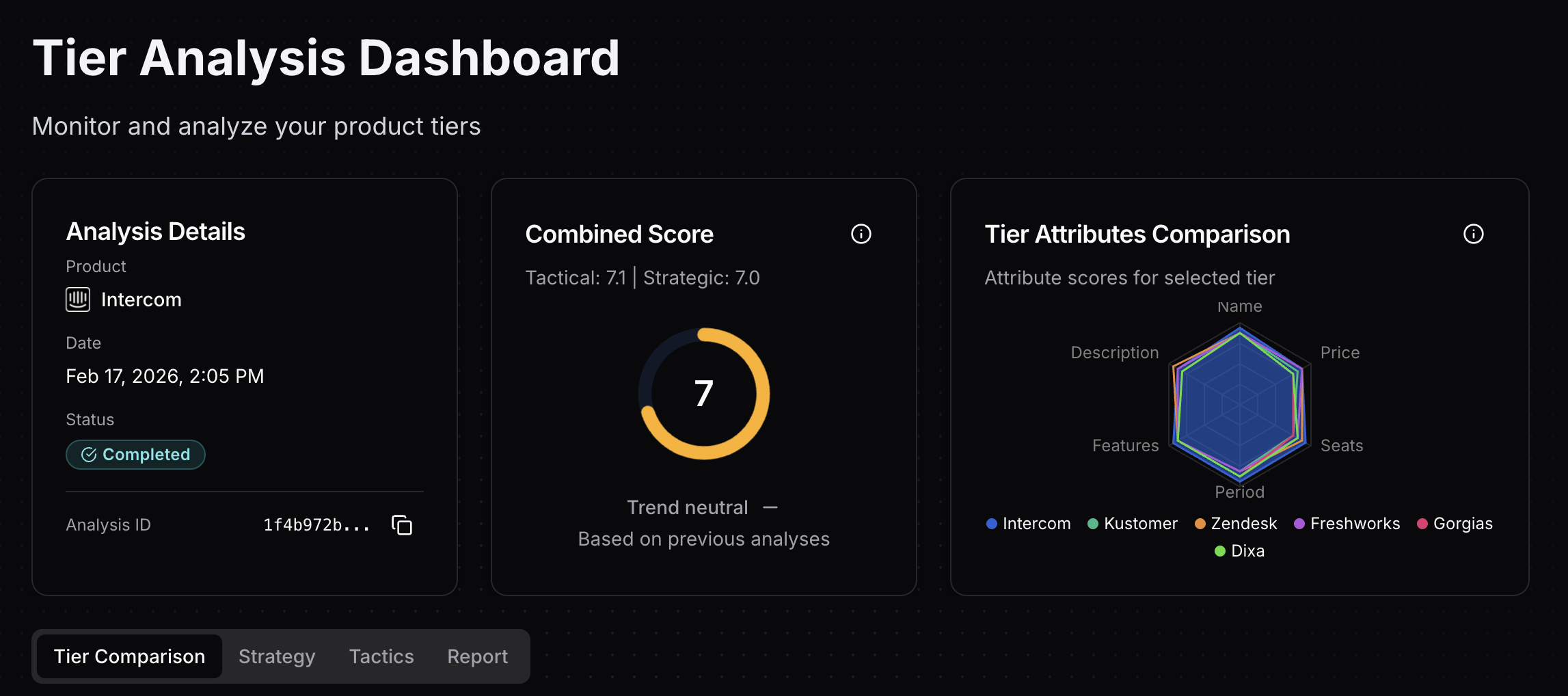 Tierly dashboard showing Intercom's 7.1 overall score with competitor comparison
Intercom takes the top spot by a meaningful margin. A 7.1 against a field averaging 6.6 means Intercom's pricing structure communicates value more effectively than any competitor in this category. But the interesting part isn't that Intercom leads. It's where it leads and where it falls short.
Intercom's strongest scoring attribute is Features (6.5 to 8.0 across tiers), reflecting well-structured feature fences. Its weakest area is pricing psychology (6/10 on the strategic assessment), driven by inconsistent annual discounts and a missing decoy effect. The gap between these two tells the story of a product team that nails feature packaging but hasn't fully optimized the behavioral economics of the pricing page.
Why Is Intercom So Expensive? (Spoiler: It's Not)
"Why is intercom so expensive?" is one of the top Google searches about Intercom pricing. The data tells a different story.
Intercom's average paid-tier monthly price is $92. Compare that to the field: Zendesk averages €137, Dixa $164, and Gorgias $277. Even Kustomer, often positioned as a value alternative, averages $67, only $25 less than Intercom with a lower Tierly score.
The "expensive" perception likely comes from two sources. First, Intercom has no free tier. Freshdesk offers a Free plan for 1-2 agents. When a buyer starts their evaluation at $0 on Freshdesk and $39 on Intercom, anchoring bias does the rest. Second, the $0.99 per Fin resolution adds unpredictable variable costs on top of the subscription, which makes total spend harder to forecast.
The reality? Intercom has the highest product score (7.1) in the competitive set at a mid-range price. Tierly's strategic assessment flags a price increase opportunity, suggesting Intercom could raise prices on Essential and Advanced without losing ground to competitors.
Intercom's Tier-by-Tier Breakdown
Tier Score Analysis
| Tier | Score | Strongest Attribute | Weakest Attribute |
|---|---|---|---|
| Essential ($39/mo) | 6.8 | Name, Price, Seats, Period (7) | Features, Description (6.5) |
| Advanced ($99/mo) | 7.3 | Name, Period, Features (7.5) | Price, Description (7) |
| Expert ($139/mo) | 7.4 | Features (8) | Price, Description (7) |
| Fin AI Agent ($0.99/res.) | 6.8 | Name, Price, Description (7) | Seats (6) |
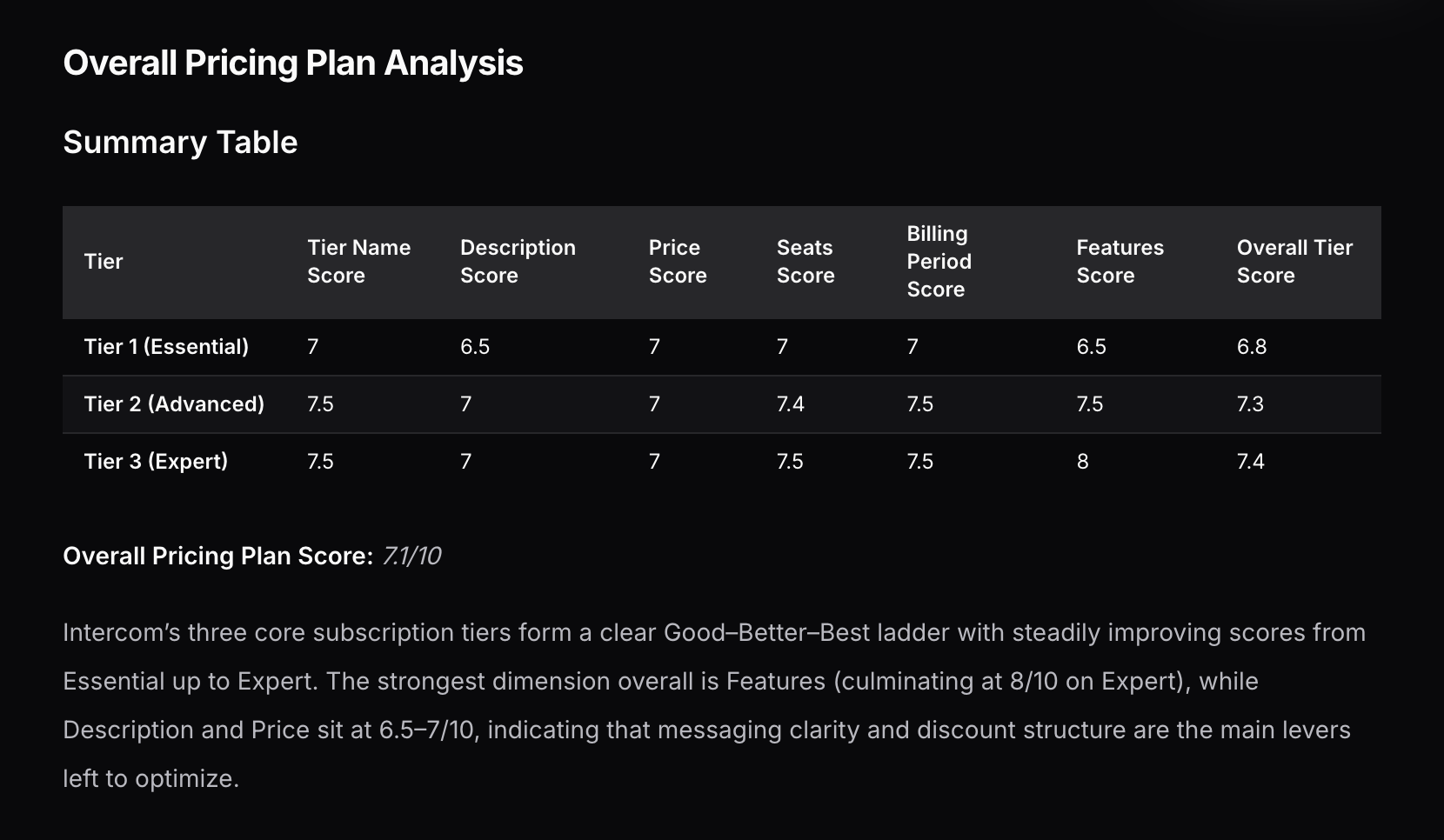 Tierly analysis showing Intercom's tier-by-tier scores and attribute breakdown
The ladder is clean. Scores rise steadily from Essential (6.8) through Advanced (7.3) to Expert (7.4), which is exactly what a well-built Good-Better-Best structure should look like. Features improve as you go up (6.5 to 8.0), and each tier targets a distinct persona with strong fit scores (8/10 across the board).
Fin AI Agent scores 6.8, slightly dragged down by the Seats attribute (6/10) because it doesn't use traditional seat-based pricing. This is a scoring artifact, not a weakness. Per-resolution pricing is the right model for an AI agent, and the analysis confirms strong alignment with Kustomer's AI for Customers and Zendesk's AI Expert tiers.
Now let's look at five strategic pricing decisions embedded in these numbers.
Lesson 1: Resolution-Based AI Pricing Rewrites the Helpdesk Business Model
Intercom charges $0.99 every time Fin AI Agent successfully resolves a customer query. No resolution, no charge. This model didn't exist in the helpdesk space two years ago. Now it's forcing every competitor to rethink how they monetize AI.
How competitors price AI:
| Platform | AI Pricing Model | Cost |
|---|---|---|
| Intercom (Fin) | Per resolution | $0.99/resolution |
| Kustomer (AI for Customers) | Per engaged conversation | $0.60/conversation |
| Freshdesk (Freddy AI) | Per session, add-on | €45 per 100 sessions |
| Zendesk (AI agents) | Bundled into Suite tiers | Included (Essential level) |
| Gorgias | Bundled automation rate | Included in ticket volume |
| Dixa (Mim AI) | Bundled into tiers | Included at all levels |
Three distinct approaches: outcome-based (Intercom, Kustomer), session-based (Freshdesk), and bundled (Zendesk, Gorgias, Dixa). Intercom and Kustomer are the only platforms that tie AI cost directly to value delivered.
Why this matters:
⦿ Alignment with buyer value. A support leader doesn't care how many AI "sessions" happened. They care about resolved tickets. Charging per resolution aligns Intercom's revenue with the outcome the buyer actually wants.
⦿ Predictable unit economics for Intercom. Each resolution has a clear cost to deliver (inference, knowledge retrieval, handoff logic) and a clear price ($0.99). This lets Intercom scale AI usage without the margin compression that bundled models risk.
⦿ Standalone distribution. Fin works with Zendesk, Salesforce, and other helpdesks. A per-resolution model makes this possible because it doesn't depend on seat-based subscription revenue. Intercom can acquire customers who aren't even on the Intercom platform.
The risk: variable costs scare budget-conscious teams. A team handling 5,000 AI resolutions per month faces an extra $4,950 on top of their seat subscriptions. That's why Tierly's strategic assessment recommends Intercom introduce volume discounts (for example, $0.79 per resolution beyond 1,000/month) to reduce friction for high-volume buyers.
Founder Takeaway: If AI handles a meaningful share of your product's value delivery, consider pricing it separately with an outcome-based metric. Bundling AI into existing tiers is simpler but hides the value. Outcome-based pricing (per resolution, per successful action, per completed workflow) creates a clear value exchange and opens distribution to users on competitor platforms. Read more about usage-based models and how they compare to per-seat pricing.
Lesson 2: Bundled Collaboration Seats Are Expansion Revenue in Disguise
Most helpdesks charge per agent. Need 10 agents? Pay for 10 seats. Intercom adds a layer: Lite seats for cross-functional collaborators who need visibility but not full agent capabilities.
Advanced includes 20 free Lite seats. Expert includes 50. No competitor in this analysis offers this level of bundled collaboration at comparable tiers.
How it compares:
| Platform | Collaborator Model | Included Free |
|---|---|---|
| Intercom Advanced | Lite seats (limited agent actions) | 20 Lite seats |
| Intercom Expert | Lite seats (limited agent actions) | 50 Lite seats |
| Zendesk Suite Professional | Comment-only agents | 100 (Suite Professional only) |
| Freshdesk Pro | Collaborators | 5,000 (but limited to viewing) |
| Kustomer Enterprise | No distinct collaborator role | N/A |
| Dixa | No distinct collaborator role | N/A |
Zendesk gates comment-only agents to Suite Professional (€115/mo annual). Freshdesk includes 5,000 collaborators on Pro, but with narrower capabilities. Kustomer and Dixa don't offer a collaborator seat type at all.
Why Lite seats are strategically smart:
⦿ They lower adoption friction. A support team doesn't buy Intercom alone. Product managers, engineers, and sales reps need access to customer conversations. Free Lite seats eliminate the "but we'd need 30 more seats" objection during procurement.
⦿ They create natural expansion triggers. A team that fills all 20 Lite seats on Advanced now has a concrete reason to move to Expert (50 seats) or buy additional Lite seat bundles. This is expansion revenue driven by usage, not arbitrary feature gates.
⦿ They build organizational switching costs. Once 20+ people across departments use Intercom daily, ripping it out becomes much harder. Each Lite seat is another person who has to learn a new tool.
Founder Takeaway: If your product naturally serves a broader audience than your primary buyer (support agents in Intercom's case), bundle read-only or limited seats with your mid and top tiers. They reduce procurement friction, create expansion triggers, and deepen organizational switching costs. The cost of serving a Lite seat is minimal compared to the retention and expansion value it creates.
Lesson 3: Your Annual Discounts Are Sending Mixed Signals
Here's a detail most Intercom pricing breakdowns miss. The annual discounts across Intercom's three tiers are wildly inconsistent:
| Tier | Monthly | Annual (per mo) | Annual Discount | Industry Best Practice |
|---|---|---|---|---|
| Essential | $39 | $29 | 25.6% | ~17% |
| Advanced | $99 | $85 | 14.1% | ~17% |
| Expert | $139 | $132 | 5.0% | ~17% |
Essential offers a generous 25.6% annual discount. Advanced drops to 14.1%. Expert gives just 5%. That spread creates three problems.
Problem 1: It signals that Expert isn't worth committing to annually. Enterprise buyers making a $132/seat/month decision should have the strongest incentive to commit annually. Instead, they save only $7/month by going annual. Compare that to Zendesk Suite Professional, which offers a 23% annual discount, or Dixa Prime at 17%.
Problem 2: It weakens the upsell path. A team on Essential annual ($29/mo) considering Advanced faces a jump to $85/mo annual. That's a 193% increase. If the annual discount on Advanced were standardized at 17%, it would be $82/mo, a marginally easier sell with a consistent savings message.
Problem 3: It dilutes Essential's perceived premium. A 25.6% discount on a $39 product risks signaling that the monthly price is inflated. The best practice range of 15-20% saves enough to motivate annual commitment without undermining monthly pricing credibility.
If you don't design your product around the price, you're just hoping you'll get lucky.
Founder Takeaway: Standardize annual discounts across all tiers, ideally between 15-20%. Inconsistent discounts confuse buyers and weaken annual commitment on the tiers where it matters most (enterprise). Use messaging like "Save ~2 months with annual" consistently across your pricing page rather than letting each tier tell a different story. This is one of the simplest, highest-impact pricing fixes available.
Lesson 4: The $60 Jump That Should Be the Default Choice
Essential to Advanced is a $60/month jump ($39 to $99). That's a 154% increase. For that premium, you get workflow automation, multiple team inboxes, round-robin assignment, a private multilingual help center, and 20 free Lite seats.
That's a lot of value. But Intercom doesn't position Advanced as the recommended choice. There's no "Most Popular" badge. No visual emphasis. No deliberate framing to steer buyers toward the middle tier.
Compare this to competitors:
⦿ Dixa labels its middle tier (Ultimate at $169/mo) as "Most Popular" directly on the pricing page.
⦿ Freshdesk labels Pro as "Most popular" in its pricing table.
⦿ Intercom? All three tiers get equal visual weight.
This is a missed decoy effect. The pricing audit framework we published covers this in detail: when your middle tier offers the best value-to-price ratio, labeling it as the recommended choice can meaningfully shift revenue mix upward.
The math tells the story:
The step-up from Essential to Advanced is 2.5x in price but includes automation, 20 extra Lite seats, multilingual support, and workflows. The step-up from Advanced to Expert is only 1.4x and primarily adds compliance features (SLAs, SSO, HIPAA). Advanced is clearly the value sweet spot, and its 7.3/10 Tierly score confirms it scores higher than Essential (6.8).
Tierly's strategic assessment rates Intercom's pricing psychology at 6/10, the lowest of the five strategic dimensions. The missing decoy is a major contributor.
Founder Takeaway: If your middle tier offers the best feature-to-price ratio, say so. A "Most Popular" or "Recommended" badge costs nothing to implement and taps into a well-documented behavioral economics principle. Your pricing page isn't a neutral menu. It's a conversion tool. Use it.
Lesson 5: You Don't Need a Free Tier If You Have a Standalone Module
Freshdesk offers a Free plan for 1-2 agents with ticketing, a knowledge base, and pre-built reports. It's a real product at zero cost. Intercom has nothing like it. Essential starts at $29/month (annual), and there's no permanent free option.
For most SaaS companies, the absence of a free tier would be a weakness. Tierly's strategic assessment flags it: persona-tier fit scores 7/10 partly because "absence of a no-cost tier leaves very small teams unserved."
But Intercom has something no competitor in this analysis offers: a standalone AI module that works on competitor platforms.
Fin AI Agent isn't locked to Intercom. It integrates with Zendesk, Salesforce, and other helpdesks. A team running Zendesk can add Fin for $0.99/resolution without switching their core platform. This creates a funnel that no free tier can match:
-
Acquire on competitor platforms. Fin resolves queries for Zendesk and Salesforce customers. These teams experience Intercom's AI without any platform migration.
-
Build switching costs through AI. Once Fin handles 30-40% of support volume, the team depends on it. When renewal time comes for Zendesk, the question shifts from "should we switch?" to "we already use Intercom's AI, should we consolidate?"
-
Convert to full platform. Advanced and Expert become the natural landing spot for teams already paying $0.99/resolution on a competitor helpdesk.
This is a product-led acquisition strategy that replaces the traditional freemium funnel. Instead of offering a limited free version of the full product, Intercom offers a full-featured paid module that hooks users at the AI layer.
Founder Takeaway: If your product has a standalone component that delivers value independently, consider making it available on competitor platforms. This works when the component creates dependency (Fin's resolution volume), when the pricing model supports it (per-resolution, not per-seat), and when the migration path from competitor to your full platform is smooth. Not every product has a module like Fin. But if yours does, it can be more effective than freemium at driving full-platform adoption.
How Intercom Compares: Matched Tier Scores
Tierly's algorithm matches each Intercom tier to the closest equivalent competitor tier based on features, positioning, and target persona. Here's how they score head-to-head:
Essential vs. Matched Competitor Tiers
| Metric | Intercom Essential | Zendesk Support Team | Freshdesk Growth | Gorgias Basic | Dixa Growth |
|---|---|---|---|---|---|
| Tier Score | 6.8 | 6.8 | 6.7 | 6.7 | 6.7 |
| Monthly Price | $39 | €25 | €20 | $50 | $109 |
| Name Score | 7 | 7 | 7 | 7 | 7 |
| Price Score | 7 | 7 | 7 | 7 | 6.5 |
| Features Score | 6.5 | 6.5 | 6.5 | 6.5 | 6.5 |
| Best Feature | Fin AI Agent included | 1,000+ integrations | Customer portal | 300 tickets/mo | All channels |
At the entry level, scores cluster tightly between 6.7 and 6.8. Intercom Essential matches Zendesk Support Team almost identically. The differentiation comes from included AI (Intercom bundles Fin, Zendesk doesn't include AI agents at this tier) and price positioning (Intercom at $39 vs Freshdesk Growth at €20).
Expert vs. Matched Competitor Tiers
| Metric | Intercom Expert | Zendesk Suite Pro | Freshdesk Enterprise | Gorgias Advanced | Dixa Prime |
|---|---|---|---|---|---|
| Tier Score | 7.4 | 7.0 | 6.8 | 6.5 | 6.6 |
| Monthly Price | $139 | €149 | €101 | $750 | $215 |
| Name Score | 7.5 | 7 | 7 | 7 | 7 |
| Features Score | 8 | 7.5 | 7.5 | 7 | 7 |
| Key Feature | HIPAA + 50 Lite seats | HIPAA + 5 help centers | Audit logs + skills routing | Dedicated email server | SSO + custom roles |
At the top of the ladder, Intercom Expert pulls away. Its 7.4 score beats every matched competitor. The 8/10 Features score reflects HIPAA support, SLAs, SSO, multibrand help center, and 50 Lite seats in a single package. And at $139/mo, it's cheaper than Zendesk Suite Professional (€149), far cheaper than Dixa Prime ($215), and dramatically cheaper than Gorgias Advanced ($750).
Tierly's Recommendations
Tierly's analysis generates specific, competitor-benchmarked recommendations for each tier. Here are the top strategic priorities the algorithm identified:
Top Strategic Recommendations for Intercom
☒ Introduce a limited Free tier to compete with Freshdesk's free plan. Cap at 1 agent, exclude Fin AI, and use it as a top-of-funnel acquisition tool for solo operators and very early-stage startups. Principle: Freemium Conversion.
☒ Standardize annual discounts at ~17% across all tiers. The current 25.6% (Essential) to 5% (Expert) spread undermines annual commitment on higher tiers and sends inconsistent pricing signals. Principle: Price Consistency.
☒ Label Advanced as "Most Popular" and visually emphasize it as the default choice. The 2.5x price ratio over Essential, combined with automation, Lite seats, and multilingual support, makes it a natural decoy. Principle: Decoy Effect.
☒ Implement a modest price increase ($5-10) on Essential and Advanced for new customers. Intercom's 7.1 product score tops the field while its $92 average price sits 33-44% below premium peers Zendesk (€137) and Dixa ($164). Grandfather existing customers. Principle: Value-Based Pricing.
☒ Introduce Fin volume discounts for high-usage customers. For example, $0.79 per resolution beyond 1,000/month. This addresses the variable cost concern while keeping the per-resolution model intact. Principle: Scaling Value Metric.
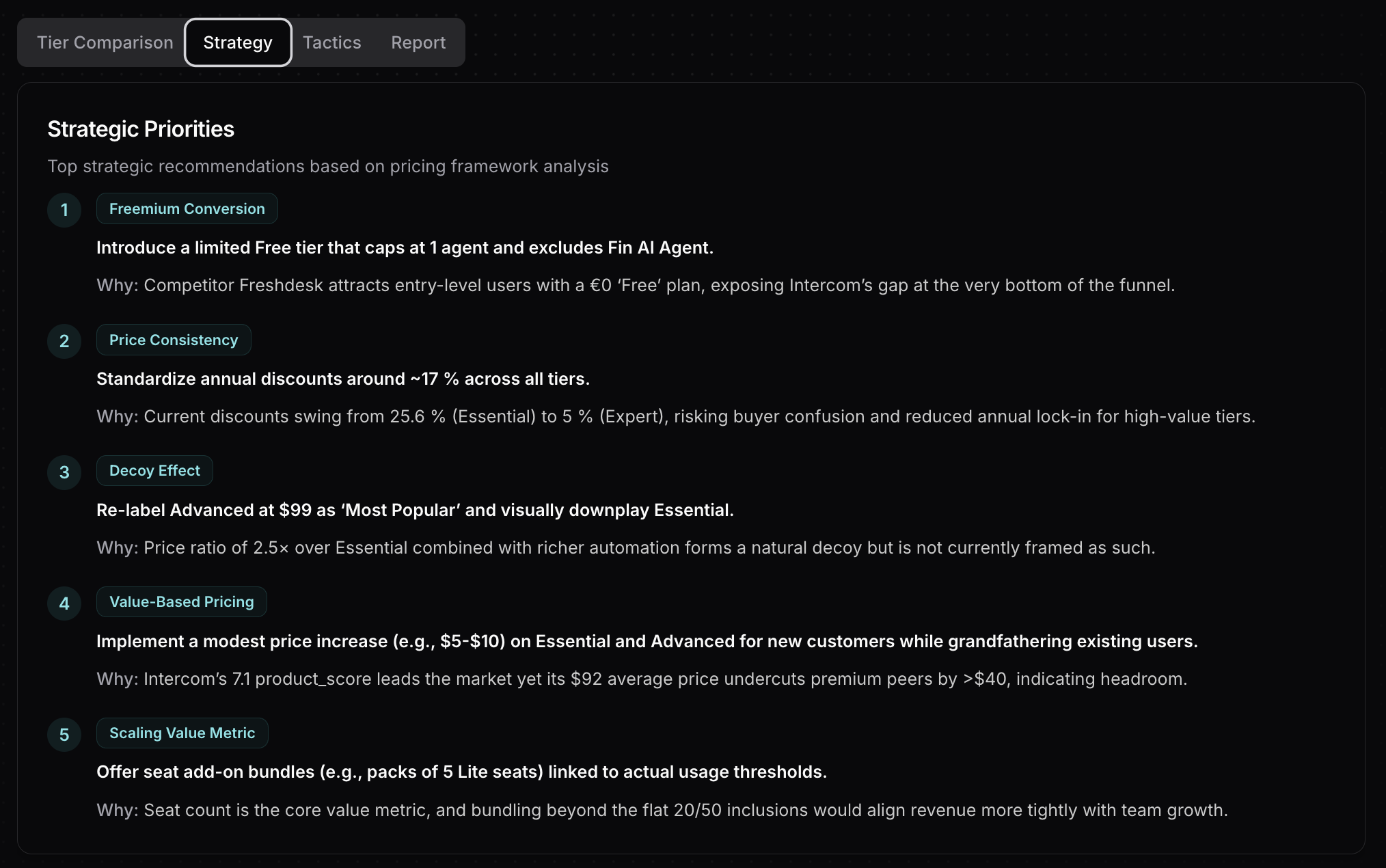 Tierly dashboard showing strategic recommendations for Intercom pricing
Each recommendation links back to specific competitor data. The freemium suggestion is directly grounded in Freshdesk's Free tier attracting entry-level users. The price increase recommendation references Intercom's score advantage over every competitor in the analysis. These aren't generic pricing tips. They're calibrated against the competitive set.
Intercom Pricing FAQ
How much does Intercom cost per month in 2026?
Why is Intercom so expensive?
How much does Intercom Fin AI Agent cost?
How does Intercom pricing compare to Zendesk?
Does Intercom have a free plan?
What is the best Intercom plan for startups?
What the Numbers Add Up To
Intercom's pricing tells the story of a company in transition. The three-tier subscription ladder is solid, well-structured, and scores highest in the competitive set. But the real innovation is happening at the edges: the $0.99 per-resolution model for Fin AI Agent and the standalone distribution on competitor platforms.
Five lessons, all backed by data:
-
Per-resolution AI pricing aligns revenue with customer outcomes and opens distribution beyond your own platform.
-
Bundled Lite seats reduce adoption friction while creating natural expansion triggers and organizational switching costs.
-
Inconsistent annual discounts (25.6% to 5%) undermine commitment on the tiers where it matters most.
-
A missing "Most Popular" label on Advanced leaves revenue on the table. When your middle tier is the best value, say so.
-
A standalone AI module can replace a free tier if it creates dependency, supports independent pricing, and feeds into platform conversion.
Intercom scored 7.1/10 against a field averaging 6.6. That gap is significant. But with a 6/10 on pricing psychology and room to optimize annual discounts, labeling, and volume pricing, the ceiling is higher. The data suggests Intercom's pricing is strong but not yet fully optimized.
Learn the 6-attribute scoring system we used to analyze Intercom's pricing tiers.
How per-resolution, per-credit, and per-workflow models compare to traditional seat-based pricing.
See how Airtable defends premium pricing against open-source alternatives scoring higher overall.
Related Posts
Slack Pricing Teardown: What SaaS Founders Can Learn
A strategic analysis of Slack's pricing structure using Tierly's competitive intelligence. 5 lessons on collaboration pricing against Zoom, Google Workspace, Webex, and Pumble.
Monday.com Pricing Teardown: What SaaS Founders Can Learn
A strategic analysis of Monday.com's pricing structure using Tierly's competitive intelligence. 5 lessons on pricing a multi-product work platform against Asana, ClickUp, Trello, Smartsheet, and Wrike.
Airtable Pricing Teardown: What SaaS Founders Can Learn
A strategic analysis of Airtable's pricing structure using Tierly's AI-powered competitive intelligence. Learn what works, what doesn't, and how to apply these lessons to your own SaaS.