Usage-Based Pricing for SaaS: Credits, Runs, and Beyond
AI broke the per-seat pricing model. Here's why SaaS companies are adopting credits, workflow runs, and hybrid billing, and how to pick the right metric for your product.
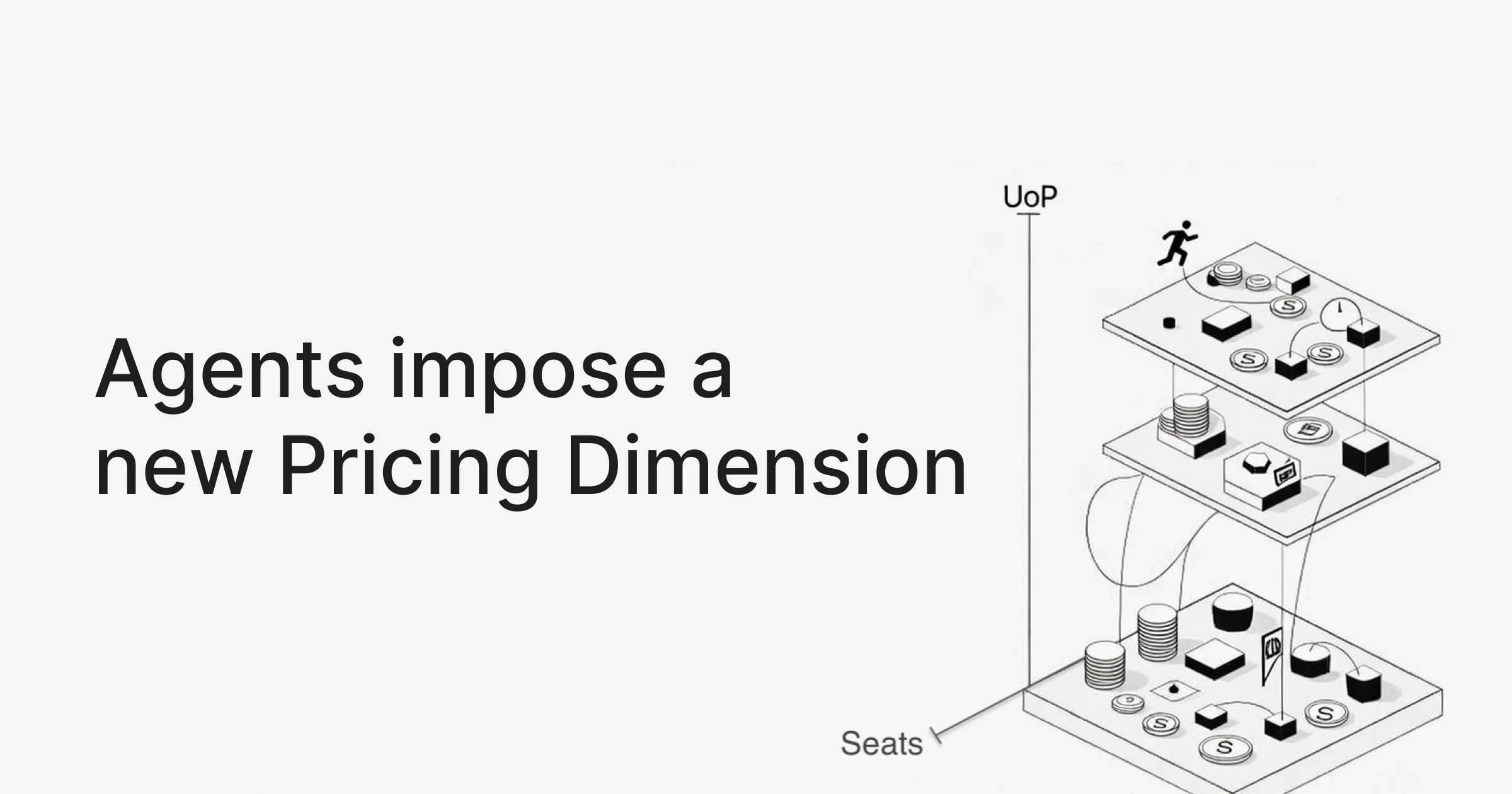
For a decade, SaaS pricing had one axis: count the humans, charge per seat. That era is ending.
Pricing plans now include seats and credits and workflow executions and AI actions, all in the same tier. These new variables, what we call Units of Process (UoP), measure the work your product performs, independent of how many humans are logged in.
If seats measure who has access, UoP measure what gets done. This isn't a subtle shift. It's a structural change in how software captures value. And the data shows it's happening fast.
Why Per-Seat Pricing Is Breaking Down
For years, the "seat" was the fundamental unit of SaaS value. One person, one license, one predictable line item. It worked because the value a product delivered scaled roughly with the number of people using it.
AI changed that equation.
When an AI agent can do the work of five people, charging per seat punishes the customer for becoming efficient. It also punishes the vendor for delivering that efficiency. If your product automates tasks that used to require a team of ten, and you charge per user, you've built a tool that reduces its own revenue as it gets better.
This is not a theoretical problem. SaaStr reports that companies are already downgrading seat counts at vendors now that they have 12+ AI agents in production. The seat is becoming disconnected from the value being delivered.
The result: SaaS companies are searching for new billing metrics that align price with output. And the market is moving quickly. The PricingSaaS 500 Index tracked over 1,800 pricing changes across the top 500 SaaS and AI companies in 2025 alone. That's 3.6 changes per company in a single year. The industry isn't tweaking pricing. It's rebuilding it.
The Rise of Credits, Runs, and Workflows
The new billing metrics go by different names, but the pattern is consistent: charge for what the product does, not who uses it.
✦ Credits
Credits give customers a pool of units they spend on product actions. Each action costs a set number of credits depending on complexity. This model has exploded in 2025.
Out of 500 companies in the PricingSaaS 500 Index, 79 now offer a credit-based pricing model, up from 35 at the end of 2024. That's a 126% year-over-year increase. Figma, HubSpot, Salesforce, Monday.com, and Airtable all adopted credits in 2025.
Why credits work: they sit in the middle of the spectrum between charging for access (seats) and charging for outcomes. They're more transparent than legacy per-seat licenses, but easier to measure than pure outcome-based billing.
✦ Workflow Executions
Workflow automation platforms like n8n charge per complete workflow run. A 50-step workflow costs the same as a 2-step workflow. One execution equals one count.
This contrasts sharply with competitors. Zapier charges per task (each step in a workflow counts separately), and Make charges per operation. Same product category, completely different billing architectures. We explored this in detail in our n8n pricing teardown.
✦ AI Actions and Conversations
Salesforce Agentforce launched at $2 per conversation, then added Flex Credits at roughly $0.005 per action (updating a record, summarizing a case, answering a question). They now offer three models in parallel: per conversation, per action, or per user at $125/month.
Cognition AI's Devin charges $2.25 per agent compute unit. No seats at all.
The common thread across all three: the billing metric is shifting from "who uses the tool" to "what the tool produces."
Real-World Examples: How SaaS Companies Bill for Usage
Usage-Based Pricing in Practice
| Company | Billing Metric | Model Type | How It Works |
|---|---|---|---|
| n8n | Workflow executions | Execution-based | 1 workflow run = 1 count, regardless of steps |
| Salesforce Agentforce | Conversations or Flex Credits | Credit/Action-based | $2/conversation or ~$0.005/AI action |
| HubSpot | AI credits (monthly reset) | Credit-based | 10-100 credits per AI task depending on complexity |
| Zapier | Tasks (per step) | Task-based | Each step in a workflow counts as 1 task |
| Make | Operations | Operation-based | Each data transformation counts as 1 operation |
| Devin (Cognition AI) | Agent compute units | Pure usage | $2.25 per ACU, no seats |
What n8n's Pricing Reveals
When we analyzed n8n's pricing with Tierly, the execution-based model wasn't just a billing detail. It was the primary reason n8n ranked #1 in our competitive pricing analysis (7.6/10), above Zapier (6.9), Make (7.0), and Pipedream (7.0).
n8n's Pro tier at $60/month for 10,000 executions undercuts Zapier Team ($103.50/month) while offering a fundamentally more generous counting method. Every complex automation becomes a value argument: "You'd pay 10x for this on Zapier."
The insight: choosing the right Unit of Process creates structural advantages that competitors can't match without rebuilding their entire billing system.
What Salesforce's Pricing Pivot Reveals
Salesforce learned the hard way that billing metrics need clarity. Their original $2/conversation model faced immediate backlash. What counts as a "conversation"? Multi-turn or single-turn? If a human finishes what an AI agent started, is that still $2?
A support team leader calculated that just 5 agents handling roughly 70 AI-assisted conversations each per day could cost $20,000+ per month. By May 2025, Salesforce added Flex Credits as an alternative, giving customers three pricing models to choose from.
The lesson: even the world's largest SaaS company struggled to define its Unit of Process clearly enough for buyers.
Hybrid Models: The New Default
Pure subscription pricing is declining. Pure usage-based pricing is too unpredictable for enterprise budgets. The answer is hybrid: a base platform fee for predictability, plus metered UoP for growth.
The numbers back this up. Companies using hybrid models report the highest median growth rate at 21%, outperforming pure subscription and usage-based models. According to BetterCloud's SaaS industry research, 46% of SaaS companies already blend subscriptions with variable charges. Furthermore, 59% expect usage-based pricing to grow their revenue share in 2026, up from 18% in 2023.
Microsoft set the template with Copilot: a $30/user base subscription plus additional credits for usage spikes. Salesforce followed with seats plus Flex Credits.
The pattern: seats for budget predictability, UoP for value capture.
| Pricing Model | Predictability | Value Alignment | Growth Potential | Best For |
|---|---|---|---|---|
| Pure per-seat | High | Low (with AI) | Limited | Traditional SaaS without AI features |
| Pure usage-based | Low | High | High | API-first products, infrastructure |
| Credit-based | Medium | Medium-High | High | AI features, variable workloads |
| Hybrid (seat + usage) | Medium-High | High | High | Most modern SaaS products |
We covered the differences between credits and monthly subscription models in our guide on credits vs monthly pricing. The short version: credits work best when your product's value varies significantly per action, while flat monthly pricing works when usage is predictable.
How to Choose Your Billing Metric
Not every SaaS product needs credits or workflow runs. But every product shipping AI features should evaluate whether per-seat pricing still captures the value being delivered.
Here's a framework for choosing the right Unit of Process:
✦ Make It Intuitive
Your billing metric should map to how customers already think about their work. n8n nails this. "One workflow execution" matches how users think about their automations. Zapier's "tasks" do not, because users don't naturally count steps inside a workflow.
⦿ Ask yourself: When your customer describes what they did with your product today, what unit do they use? "I ran 50 workflows" is intuitive. "I consumed 14,000 operations" is not.
✦ Make It Predictable
Customers need to forecast their bills without a spreadsheet. n8n's Business tier scores 6.7/10 on price perception in our Tierly analysis despite strong features (8.9/10). The price isn't necessarily wrong. The translation is missing. Buyers can't map "40,000 executions" to their actual workload without help.
⦿ Build calculators and estimators. Show customers what their typical usage looks like in your billing metric. Provide "recommended plan" flows based on team size and workload descriptions.
✦ Make It Aligned
More usage should mean more value delivered, not just more cost. If customers feel penalized for using your product more, you have an alignment problem.
⦿ Test the incentive: Does your billing metric encourage customers to use the product more, or does it create anxiety about overages? The best metrics make customers think "I should upgrade because I'm getting so much value," not "I need to be careful how much I use this."
If you don't design your product around the price, you're just hoping you'll get lucky.
This applies directly to billing metrics. If you pick a Unit of Process as an afterthought, you're hoping customers will understand it. Design your product experience around the metric. Show usage in dashboards. Send notifications before limits are reached. Make the billing metric feel like a feature, not a tax.
The Tension Ahead: Complexity vs. Simplicity
There's a paradox forming in SaaS pricing.
In 2025, the pendulum swung hard toward credits and usage-based complexity. In 2026, it's already swinging back. Customers want the value alignment of usage-based pricing but the simplicity of flat subscriptions.
The companies that win will find UoP that balance both:
⦿ Intuitive enough that customers already think in this unit
⦿ Predictable enough that customers can forecast their bill
⦿ Aligned enough that more usage equals more value delivered, not just more cost
n8n's execution-based model hits all three. One workflow run is intuitive, predictable, and value-aligned. Zapier's per-task model misses on predictability because users can't easily estimate how many "tasks" a workflow will consume. Same market, different clarity, different competitive position.
Your billing metric isn't a finance decision. It's a product decision that shapes how customers perceive value, how they compare you to competitors, and whether they upgrade or churn. Choose a unit that matches how your customers experience value. Make it legible. And don't be afraid to let it coexist with seats.
Because in the next era of SaaS, the question isn't just "how many people use your product?" It's "how much work does your product actually do?"
Usage-Based Pricing FAQ
What is usage-based pricing in SaaS?
What is credit-based pricing and how does it work?
Why are SaaS companies moving away from per-seat pricing?
What is hybrid pricing for SaaS?
How do I choose the right billing metric for my SaaS product?
Compare credit-based and subscription pricing models to find the right fit for your product.
Build CI reports that include pricing model analysis and help you benchmark against competitors.
Learn the fundamentals of pricing intelligence and how to build a systematic approach to tracking competitors.
Related Posts

Credits vs Monthly Pricing: Which Model Fits Your Startup?
Should your SaaS use credits or monthly limits? This guide breaks down both pricing models with real examples and a decision framework for startups.

Per-Seat vs Usage-Based Pricing: How to Choose for SaaS
Seat-based pricing is under pressure from AI and usage-based models. This guide breaks down when each model works, the hybrid approach most SaaS companies are adopting, and a framework for making the right choice.

Competitive Pricing Strategy: Complete SaaS Guide (2026)
A practical guide to competitive pricing strategy for SaaS founders. Learn frameworks, avoid common mistakes, and build pricing that wins deals.