Slack Pricing Teardown: What SaaS Founders Can Learn
A strategic analysis of Slack's pricing structure using Tierly's competitive intelligence. 5 lessons on collaboration pricing against Zoom, Google Workspace, Webex, and Pumble.
Slack is the company that redefined how teams communicate. It killed the internal email thread, gave engineers their channel-based home, and became the default integration layer for hundreds of SaaS tools. But product leadership and pricing sophistication are two very different things.
We ran Slack through Tierly's AI pricing analysis (March 10, 2026) and benchmarked it against four direct competitors: Zoom, Google Workspace, Webex, and Pumble. The result is a 6.6/10 combined score, enough to lead this competitive set, but not enough to call Slack's pricing strategy a strength.
The gap between Slack's market dominance and its pricing page sophistication is the real story.
Slack leads its competitive set with a 6.6/10 combined score. The next closest is Zoom at 6.4/10. But Slack's Pricing Psychology score of 5/10 (the lowest strategic dimension in the analysis) suggests the category leader is leaving real money behind.
What Is Slack's Pricing in 2026?
Slack uses per-seat pricing across four tiers, from a generous-looking Free plan to a fully opaque Enterprise Grid. The model is standard for collaboration SaaS: charge per user, gate on features, hide enterprise pricing behind a sales call.
| Plan | Price (per seat/mo) | Billing | Key Features |
|---|---|---|---|
| Free | €0 | N/A | 90-day message history, 10 app integrations, 1:1 video/audio meetings |
| Pro | €4.13 | Annual | Unlimited message history, unlimited integrations, group video meetings, Slack canvas |
| Business+ | €9.00 | Annual | SAML SSO, SCIM provisioning, AI file summaries, 99.99% SLA, compliance exports |
| Enterprise+ | Contact Sales | Annual | DLP, EMM integration, Enterprise Key Management, advanced admin |
The four-tier architecture is clean and logical: Pro unlocks productivity, Business+ unlocks security and AI, Enterprise+ unlocks enterprise controls. The problem is not the structure; it's the execution at each rung.
How Tierly Analyzed Slack's Pricing
For this analysis, Tierly evaluated four direct competitors across Slack's core positioning: team communication, workflow automation, and AI-assisted collaboration.
Zoom Workplace is Slack's closest feature-rival in the suite-based collaboration space. Zoom now bundles Team Chat alongside meetings, whiteboard, and AI Companion, making it a credible all-in-one alternative for teams already paying for Zoom meetings. The pricing comparison here reveals whether Slack's chat-first positioning holds up on value.
Google Workspace (with Google Chat and Spaces) is the default collaboration suite for startups and SMBs running on Gmail. For any company choosing between Slack and Google Chat, the pricing delta and feature comparison is a core purchasing decision. Google Workspace also has the most transparent pricing in this group, a useful benchmark for what "complete pricing pages" look like.
Cisco Webex represents the enterprise end of the market, where security, compliance, and reliability take precedence over product UX. Webex Suite at $25/seat competes with Slack Business+ for the security-first enterprise buyer. Comparing their mid-tier and enterprise value is essential for Slack's competitive positioning story.
Pumble is the most important budget reference point in this analysis. At €2.99/seat for PRO, with unlimited message history even on their Free plan, Pumble represents exactly what Slack's Free-to-Pro conversion story is fighting against. If a price-sensitive team can get unlimited history for free with Pumble, Slack's 90-day Free limit needs to deliver more than access restriction.
Microsoft Teams was included in the initial analysis scope. Pricing data extraction from Microsoft's comparison page was limited, so it is excluded from the scored tier comparison. For a Teams vs. Slack pricing breakdown, the SaaS Pricing Audit Framework covers the methodology for building that comparison yourself.
Slack's Pricing Score: 6.6/10
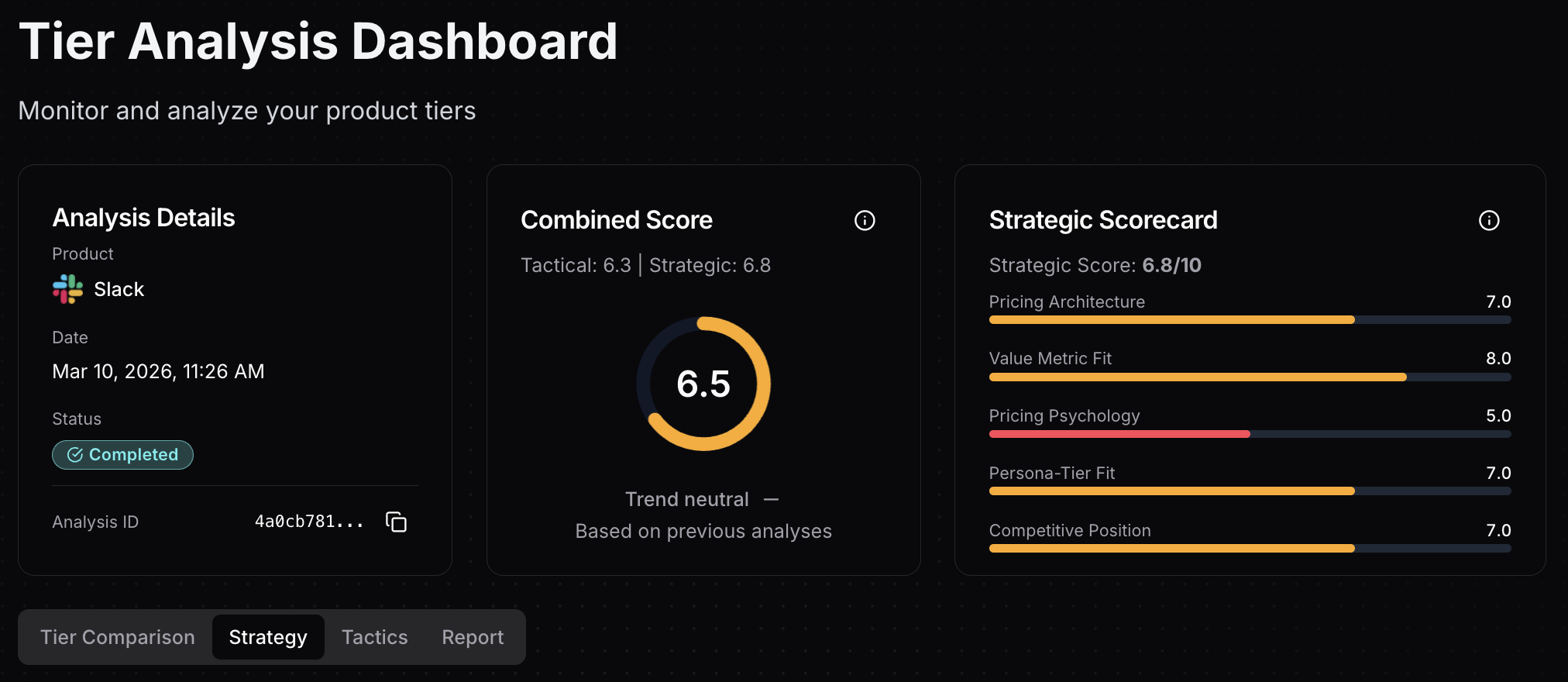 Slack pricing analysis on Tierly's dashboard showing tier scores and strategic assessment across Free, Pro, Business+, and Enterprise+
Tierly scores seven attributes per tier (name clarity, pricing, seat flexibility, billing terms, feature depth, description quality, and conversion signals) plus five strategic dimensions. Here is how the strategic picture breaks down.
Slack Strategic Pricing Assessment
| Dimension | Score | Key Finding |
|---|---|---|
| Value Metric Alignment | 8/10 | Per-seat pricing is well-matched to Slack's usage patterns and buyer psychology across all segments |
| Pricing Architecture | 7/10 | Four-tier ladder is logical, but the Pro-to-Business+ step-up is steep at 118% |
| Persona-Tier Fit | 7/10 | Tiers map reasonably to SMB/mid-market/enterprise segments, but Business+ conflates IT buyers and AI users into one upgrade |
| Competitive Positioning | 7/10 | Slack leads the competitive set in combined score, but Pro is significantly under-priced relative to Zoom and Webex equivalents |
| Pricing Psychology | 5/10 | No charm pricing, no 'Most Popular' label, no Enterprise+ price anchor. The single biggest correctable miss on the pricing page |
The 8/10 on Value Metric is the anchor of Slack's strategic score. Per-seat pricing makes immediate sense for team communication: value scales directly with team size, and the pricing unit fits the buyer's mental model. But the 5/10 on Pricing Psychology drags the strategic average to 6.8/10, and it is the most fixable problem on the page.
Lesson 1: The 90-Day Message History Limit Is a Trust Tax, Not a Conversion Strategy
Slack's Free tier scores 6.2/10, the second-lowest in the analysis, ahead only of Enterprise+. The ceiling is not the 10-app integration limit or the 1:1-only video meetings. It is the 90-day message history wall.
What Slack gets right on Free:
⦿ Unlimited team members. Slack's Free plan has no seat cap, which makes early-stage adoption frictionless. A 50-person startup can all join Slack before the first paid seat is purchased.
⦿ 1:1 video and audio meetings included. Direct video huddles at zero cost means Free users experience real collaboration value, not just text chat.
⦿ Access to Slack's full integration ecosystem (up to 10 apps). Even on Free, users can connect Notion, Jira, GitHub, and Google Drive. This is a genuine preview of what makes Slack sticky at scale.
The insight for founders:
The 90-day message history limit is structurally different from every other free-tier limit in this analysis. Seat limits and feature limits define what you cannot do yet. History limits define what you can no longer access: conversations that happened, decisions that were made, files that were shared.
That distinction matters psychologically. A team six months into Slack has invested real organizational context into the product. When the 90-day wall arrives, they do not discover they need an upgrade. They discover their memory has been taken away.
Pumble offers unlimited message history on its free tier. Zoom Basic limits recording but does not retroactively remove access to chat history. The framing difference is significant: Pumble's free limit says "we are generous now, you will want more later." Slack's free limit says "the more you use us, the more expensive leaving becomes." One creates loyalty through value. The other creates loyalty through lock-in. Teams notice the difference.
A better free-tier fence for Slack: limit search capabilities (only search the last 90 days) rather than access. Let users read all conversations but only search efficiently across recent history. The upgrade motivation stays. The resentment disappears.
The best freemium offerings provide the full functionality of the product for free, but find a measurement that the customer will likely exceed that draws them into paying.
Founder takeaway: If your free tier limits create resentment rather than desire, your upgrade conversion will underperform. Design limits around what users want more of, not around what they have already accumulated.
Lesson 2: Slack Pro Is Priced for Market Share. That Is Both Its Strength and Its Ceiling.
Slack Pro scores 6.6/10. At €4.13/seat/month billed annually, it is one of the most affordable entry-level paid collaboration tiers in this competitive set. That affordability is a deliberate strategy, and a double-edged one.
What Slack gets right with Pro:
⦿ Unlimited message history. The upgrade from Free is compelling and clear. Day 91 on Free is the natural inflection point, and Pro's value proposition is unambiguous: everything you had, plus everything you missed.
⦿ Unlimited app integrations. Moving from 10 to unlimited apps is a meaningful capability unlock for engineering and ops teams who build workflows on top of Slack's ecosystem.
⦿ Slack canvas and video clips included. Docs and async video at the Pro level add collaborative value that competitors do not always match at equivalent price points.
The insight for founders:
Compare Slack Pro to its matched competitors in Tierly's analysis:
- Zoom Pro: $16.99/seat (4x more expensive)
- Webex Meet: $14.50/seat (3.5x more expensive)
- Google Workspace Standard: €12.96/seat (3x more expensive)
- Pumble PRO: €2.99/seat (€1.14 cheaper)
Slack Pro is dramatically underpriced relative to Zoom and Webex for collaboration value delivered. That creates a strong acquisition story: easy to sell on price. But it also sets a ceiling on how Slack is perceived in the market. When teams think "Slack is cheap," they do not think "Slack is essential."
There is a second miss: no visible annual discount is surfaced as a pricing lever. A prominent "Save 20% with annual billing" toggle can lift annual plan adoption by 15-30%, a material LTV improvement with no product changes required.
If not a single customer ever complains that you're too expensive, that's a strong sign that you're too cheap.
Founder takeaway: If you are the market leader and your entry paid tier costs a fraction of competitors' equivalents, ask whether you are capturing value or giving it away. Penetration pricing builds market share, until it becomes the ceiling on your brand's perceived value.
Lesson 3: Bundling AI Into Business+ Creates a 118% Step-Up That Loses the Middle
Business+ is Slack's highest-scoring tier at 6.8/10. It bundles SAML-based SSO, SCIM provisioning, AI-powered file summaries, compliance exports, and a 99.99% uptime SLA, genuinely differentiated capabilities at the €9/seat level.
The problem is the math: €4.13 to €9.00 is a 118% price increase. That is the largest percentage step-up in this competitive set.
What Slack gets right with Business+:
⦿ AI file summaries at Business+. Including AI in the mid-tier rather than the enterprise tier democratizes AI access and creates a clear upgrade story that is distinct from pure compliance motivations.
⦿ 99.99% uptime SLA. Committing to uptime guarantees at the mid-market level signals that Slack is serious about business continuity without requiring a full enterprise contract.
⦿ Compliance exports included at Business+. Message exports for compliance are essential for financial services, healthcare, and legal teams. Delivering them at Business+ rather than Enterprise+ is genuine competitive differentiation.
The insight for founders:
Business+ serves two distinct buyer types in one upgrade: the IT/security buyer (who needs SAML, SCIM, and compliance exports) and the productivity buyer (who wants AI summaries and better reliability). These are often different people, making different purchasing decisions on different timelines.
When your mid-tier serves two distinct personas, you raise the barrier for both. The productivity buyer does not need SSO and resists paying for it. The IT buyer does not control the discretionary budget and cannot move without a procurement cycle.
A cleaner alternative: introduce an AI add-on at around €3/seat for Pro users. Let productivity buyers access AI file summaries without the full compliance bundle. IT buyers still upgrade to Business+ for SAML and SCIM. The total addressable upgrade pool at the Pro level expands. Mid-market ARR grows without requiring all Pro users to justify a 118% price increase to their finance team.
Google charges €12.96 for Google Workspace Standard, which includes Gemini AI access. Webex Suite with AI Companion is $25/seat. Slack Business+ at €9 with AI summaries is aggressive pricing. The issue is not the tier itself but the step-up architecture that forces buyers to choose between AI and compliance as a single bundled decision.
You used to do maybe a pricing change once per year. Now it's three, four, or even five changes in a relatively short period just to keep up with shifting costs and adoption.
Founder takeaway: If your mid-tier bundles two distinct buyer personas into one upgrade, test splitting them. An AI add-on at a lower price point can unlock upgrade conversions that the full bundle tier misses, without cannibalizing Business+ for compliance buyers.
Lesson 4: A 5/10 Pricing Psychology Score Is Leaving 15-20% Revenue on the Table
Slack's weakest strategic score is not in a specific tier. It is across the entire pricing page. Tierly's Pricing Psychology dimension scores 5/10, and this is the most correctable miss in the analysis.
What Slack underdelivers on pricing psychology:
⦿ No charm pricing. Slack Pro is listed at €4.13/seat rather than €3.99 or €4.09. Charm pricing is not manipulation. It is friction reduction at the decision moment. €4.13 reads as a number extracted from a spreadsheet, not one designed for conversion.
⦿ No visible "Most Popular" label. None of Slack's pricing tiers surface a recommended or most-popular designation. This is one of the highest-ROI elements in SaaS pricing pages. It steers undecided buyers toward the right tier and drives 20-30% of mid-tier conversions in well-designed pricing pages.
⦿ No price anchor on Enterprise+. Enterprise Grid lists three features and a Contact Sales button with no pricing. Not even a "from €X/seat/month" reference. Enterprise buyers begin pricing research before they engage sales. Without an anchor, they use Webex ($25/seat) or Zoom Enterprise as their mental benchmark, which is not necessarily to Slack's advantage.
⦿ Annual discount not surfaced prominently. If Slack offers a discount for annual billing, it should be the first thing buyers see when landing on the pricing page. Buried fine print or absent toggle means annual plan adoption is lower than it should be.
The insight for founders:
Pricing psychology is not optional for companies at Slack's scale. These are table-stakes optimizations that compound across millions of purchasing decisions:
- Charm pricing alone can lift conversion 5-8% on the target tier
- A "Most Popular" badge steers undecided buyers toward the desired tier in 20-30% of cases
- Enterprise anchoring increases qualified inbound pipeline by setting expectations before the sales call
- Annual billing surfaced prominently increases LTV per customer 15-25%
None of these require product changes. They are pricing page copy and design decisions. That Slack scores 5/10 here, at its scale and with its resources, suggests these basics have not been systematically applied. As Lincoln Murphy, who has spent years advising SaaS companies on pricing strategy, puts it:
Pricing is a function of Marketing.
Founder takeaway: Before optimizing features or adding tiers, audit your pricing page psychology. Charm pricing, plan recommendation labels, and enterprise anchors are among the highest-ROI pricing improvements you can make, with no engineering work required.
Lesson 5: Enterprise+ With 3 Listed Features Is a Sales Conversation Killer
Enterprise+ is Slack's lowest-scoring tier at 5.5/10. Not because the product is weak. Enterprise Slack is genuinely powerful. The problem is the pricing page representation of that product.
What Slack lists for Enterprise+:
⦿ Data Loss Prevention (DLP). Critical for regulated industries and large organizations handling sensitive information.
⦿ EMM (Enterprise Mobile Management) integration. Mobile device management integration for enterprise IT environments.
⦿ Enterprise Key Management. Customer-managed encryption keys, a serious enterprise security capability that few competitors at this tier offer explicitly.
The insight for founders:
Three features and a "Contact Sales" button is not an enterprise pricing page. It is a placeholder that forces the buyer to do all their research with a sales rep rather than on your website.
Enterprise procurement teams (IT, legal, security, and finance) begin their research independently. They need to answer questions like: Does Slack have SOC 2 Type II? ISO 27001? HIPAA BAA? What SSO options exist beyond SAML? Is there a dedicated CSM? What are the contract terms? None of these appear on the Enterprise+ pricing page.
That means every enterprise prospect who lands there leaves without the information they need to build an internal business case. Some will book a demo. Many will not.
Compare to Pumble's approach: transparent Enterprise pricing at €7.99/seat with a full feature list including compliance specifics and dedicated support details. Pumble is not an enterprise product, but its pricing page communicates confidence and completeness that Slack's Enterprise+ does not.
The fix is not complicated: add a "from €X/seat/month" anchor (even if actual price varies by deal size), expand the feature list to 8-10 items covering compliance, security, deployment, and support, and add a downloadable enterprise overview for procurement teams who will not book a cold sales call.
Low pricing alone isn't disruptive, it's just cheap.
Founder takeaway: If your enterprise tier listing has fewer than 8 features and no price anchor, you are forcing qualified pipeline to rely entirely on sales conversations for basic research. Add a price floor, expand the feature list, and include the compliance and security specifics that procurement teams need to self-qualify.
How Slack Compares to Zoom, Google Workspace, Pumble, and Webex
Tierly's analysis benchmarked Slack against four competitors across equivalent tier matches. Here is the full competitive picture.
| Product | Free Tier | Entry Paid (/seat/mo) | Mid Tier (/seat/mo) | Enterprise | Score |
|---|---|---|---|---|---|
| Slack | Free (90-day history) | Pro: €4.13 | Business+: €9.00 | Contact Sales | 6.6/10 ⬆ |
| Zoom | Basic (free) | Pro: $16.99 | Business: $21.99 | Contact Sales | 6.4/10 |
| Google Workspace | N/A | Starter: €5.67 | Standard: €12.96 | Contact Sales | 6.3/10 |
| Pumble | Free (unlimited history) | PRO: €2.99 | BUSINESS: €4.99 | ENTERPRISE: €7.99 | 6.3/10 |
| Webex | Free | Meet: $14.50 | Suite: $25.00 | Contact Sales | 6.1/10 |
Slack leads the competitive set on combined score, but the margin is narrow: Zoom is 0.2 points behind. The entire category scores between 6.1-6.6, suggesting that team collaboration pricing as a category is functional rather than strategic. No player in this set has cracked the 7+ threshold that would signal genuine pricing sophistication.
Three things stand out from the comparison:
Slack Pro is dramatically under-priced relative to Zoom and Webex. At €4.13 vs. $16.99 (Zoom Pro) and $14.50 (Webex Meet), Slack delivers comparable or superior collaboration value at 75% lower cost. This is a deliberate market-share strategy, but it limits revenue expansion and sets a low anchor for how buyers perceive Slack's value.
Pumble is the only competitor with transparent Enterprise pricing. €7.99/seat for ENTERPRISE is a bold transparency move that resets buyer expectations for the whole category. Slack, Zoom, Google, and Webex all hide their enterprise pricing, creating an industry-wide opacity that Pumble has opted out of entirely.
Google Workspace wins on bundle value for existing Google users. For teams that live in Google Docs and Gmail, Google Workspace Starter at €5.67/seat (with Drive, Meet, Calendar, and Chat) represents strong bundled value that Slack cannot match as a standalone product.
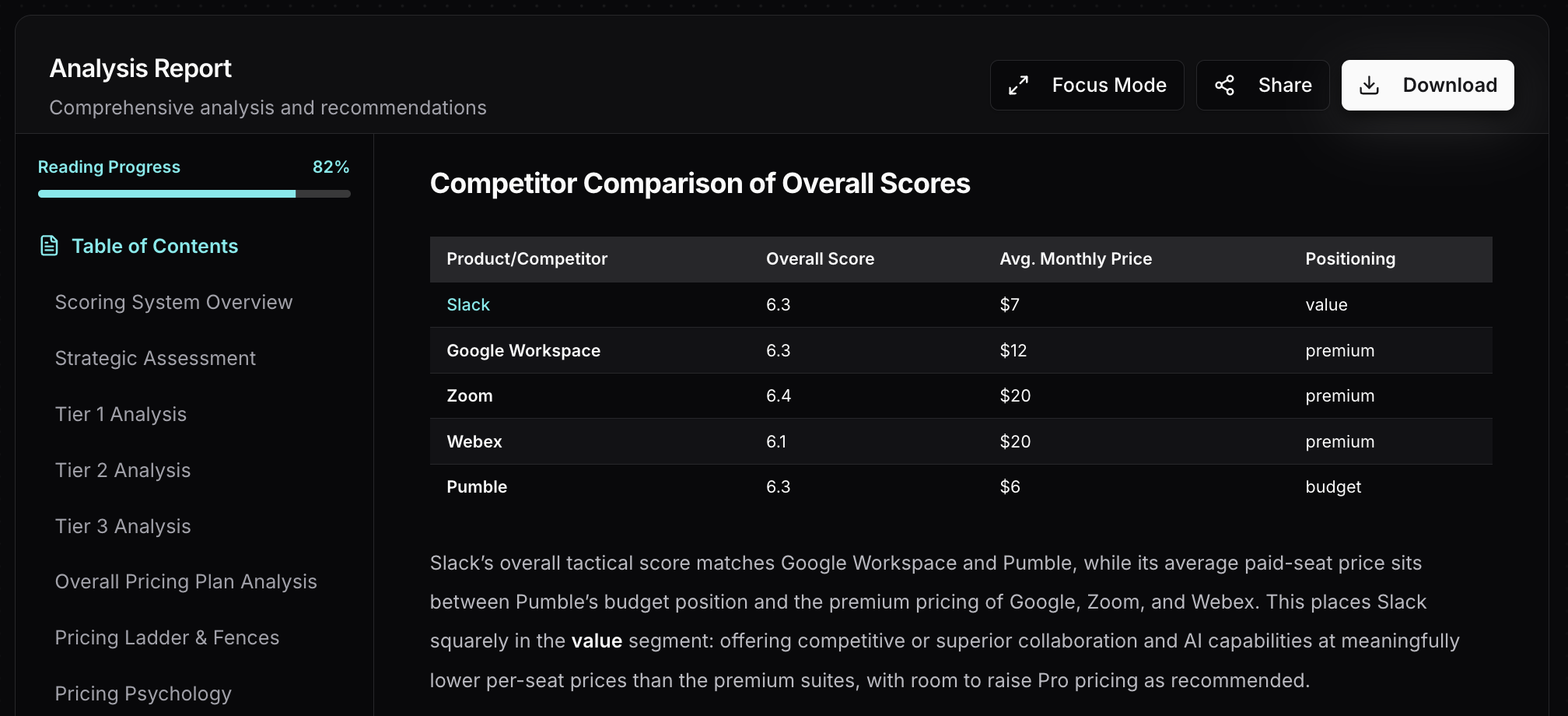 Slack competitor pricing comparison from Tierly showing combined scores for Zoom, Google Workspace, Pumble, and Webex
What Tierly Recommends for Slack
Based on the full analysis, six recommendations would meaningfully improve Slack's pricing effectiveness without requiring product changes.
Slack Tier-by-Tier Recommendations
| Tier | Recommendation | Expected Impact |
|---|---|---|
| Free | Shift the history limit from access restriction to search restriction: let users see all history but only search the last 90 days on Free | Reduces resentment-driven churn; maintains conversion pressure on search-heavy and growing teams |
| Pro | Raise to €4.99/seat/month annually and make the annual vs. monthly discount prominently visible on first scroll | 15-20% LTV increase; positions Pro above budget alternatives without losing the value story |
| Pro | Introduce an AI add-on at €3/seat for conversation summaries and channel digests | Captures AI-motivated upgrades without requiring the full Business+ step-up; expands mid-market ARR |
| Business+ | Add a visible 'Most Popular' label and separate the AI and compliance upgrade narratives in tier description copy | Reduces 118% step-up friction; increases mid-tier conversion from Pro by clarifying what each buyer type actually gets |
| Enterprise+ | Add 'from €X/seat/month' anchor, expand feature list to 10+ items, include compliance certifications (SOC 2, ISO 27001, HIPAA BAA), and add a downloadable enterprise overview | Increases qualified enterprise inbound; reduces sales cycle length for procurement-gated deals |
| Pricing Page | Apply charm pricing across all tiers (€3.99, €8.99 vs. €4.13, €9.00) and ensure annual billing is the default visible option | 5-10% conversion lift on Pro; signals pricing intentionality to sophisticated buyers evaluating multiple tools |
The highest-leverage recommendation: fix the Pricing Psychology score. All six improvements above require no product changes, no new features, and no engineering work. They are pricing page copy and design decisions that directly impact conversion at the two highest-traffic moments: Free-to-Pro and Pro-to-Business+.
For a deeper look at how Tierly approaches this kind of analysis on your own product, see the competitive pricing analysis guide or run your own free analysis at Tierly.
Slack Pricing FAQ
How much does Slack cost per month in 2026?
Is Slack's free plan worth it for teams?
What's the difference between Slack Pro and Business+?
How does Slack pricing compare to Microsoft Teams?
What is the best Slack plan for startups?
The 5 Pricing Lessons from Slack
Slack is the market leader in team collaboration. Its pricing is competent, structurally sound, and leads this competitive set on combined score. But for a company with Slack's brand power, distribution, and product depth, a 6.6/10 is underperforming the opportunity.
✦ Lesson 1: History limits breed resentment. Design free-tier limits around what users want more of, not what they have already accumulated. Shift from access limits to capability limits.
✦ Lesson 2: Penetration pricing builds market share, until it becomes a ceiling. If your entry paid tier costs a fraction of competitors' equivalents, ask whether you are winning adoption or capping your brand's perceived value.
✦ Lesson 3: Bundling AI with compliance creates a 118% step-up problem. When your mid-tier serves two distinct buyer personas (IT buyers and productivity buyers), you raise the barrier for both. Test separating them.
✦ Lesson 4: Pricing psychology is the highest-ROI pricing improvement you are not making. Charm pricing, plan labels, and enterprise anchors require no engineering work and drive 10-20% conversion improvement when implemented correctly.
✦ Lesson 5: An enterprise pricing page with 3 features and a Contact Sales button is not a pricing page. It is a pipeline friction creator. Give procurement teams what they need to build a business case before the first sales call.
The gap between Tierly's 6.6/10 and a market-leading 8+ is not in the product. It is in the pricing page. The improvements are knowable, testable, and fast to implement. If the category leader is leaving this much on the table, most SaaS pricing pages are too.
We analyzed Intercom's dual-layer pricing model against five competitors. 5 lessons on value metric choice, add-on architecture, and enterprise packaging for customer communication SaaS.
Monday.com scored 7.6/10 in Tierly's analysis. 5 lessons on multi-product pricing, seat minimums, and feature gating, with a direct comparison to Asana, ClickUp, Trello, and Smartsheet.
A step-by-step framework for auditing your SaaS pricing, covering value metrics, competitive positioning, tier architecture, and pricing psychology.
Compare the top tools for competitive pricing intelligence, from manual benchmarking approaches to AI-powered platforms like Tierly.
Everything you need to know about building a competitive pricing intelligence process, from data collection to strategic action and continuous benchmarking.
Related Posts
Monday.com Pricing Teardown: What SaaS Founders Can Learn
A strategic analysis of Monday.com's pricing structure using Tierly's competitive intelligence. 5 lessons on pricing a multi-product work platform against Asana, ClickUp, Trello, Smartsheet, and Wrike.
HubSpot Pricing Teardown: What SaaS Founders Can Learn
A strategic analysis of HubSpot Marketing Hub's pricing structure using Tierly's competitive intelligence. 5 lessons on value ladder breaks, seat regression, and contact-based pricing against Salesforce, Zoho, Dynamics 365, Freshworks, and Zendesk.
Intercom Pricing Teardown: What SaaS Founders Can Learn
A strategic analysis of Intercom's pricing structure using Tierly's competitive intelligence. 5 lessons on pricing AI-powered customer service against Zendesk, Freshdesk, Kustomer, Gorgias, and Dixa.