HubSpot Pricing Teardown: What SaaS Founders Can Learn
A strategic analysis of HubSpot Marketing Hub's pricing structure using Tierly's competitive intelligence. 5 lessons on value ladder breaks, seat regression, and contact-based pricing against Salesforce, Zoho, Dynamics 365, Freshworks, and Zendesk.
HubSpot is the company that defined inbound marketing. It built the playbook, coined the terminology, and turned a CRM into a platform that spans marketing, sales, service, content, data, and commerce. Over 228,000 customers use HubSpot across 135+ countries.
But building a category-defining product and building a category-defining pricing page are different disciplines. HubSpot's product execution scores 6.8/10 in Tierly's tactical analysis. Its strategic pricing architecture scores 6.0/10. That 0.8-point gap is the largest tactical-to-strategic spread we have measured in any teardown, and it reveals a specific, fixable problem: HubSpot's product is better than its pricing page communicates.
We ran HubSpot Marketing Hub through Tierly's AI pricing analysis (April 2, 2026) and benchmarked it against five direct competitors: Salesforce, Zoho One, Microsoft Dynamics 365, Freshworks CRM, and Zendesk. The combined score is 6.4/10. Not low enough to call HubSpot's pricing broken. Not high enough to call it optimized for a platform of this scale.
What Is HubSpot's Pricing in 2026?
HubSpot Marketing Hub uses flat monthly pricing across four tiers, with contact caps embedded inside each plan. The model bundles seats, credits, and marketing contacts into fixed packages rather than scaling price with a single usage metric.
| Plan | Price (/mo) | Contacts | Seats | Key Features |
|---|---|---|---|---|
| Free | €0 | N/A | 2 | Free marketing, sales, service, content, and data tools |
| Starter | €15 (€9 annual) | 1,000 | 1 | Email marketing, forms, live chat, simple automation, ad retargeting |
| Professional | €880 (€792 annual) | 2,000 | 3 | Omni-channel automation, lead scoring, advanced personalization, custom reporting |
| Enterprise | €3,330 | 10,000 | 5 | Journey analytics, multi-touch attribution, access controls, email approvals |
The four-tier structure looks like standard Good-Better-Best pricing. The problem is not the number of tiers. It is the spacing between them. €15 to €880 is not a step-up. It is a cliff.
Two additional costs are buried in footnotes: Professional requires a one-time €2,930 onboarding fee. Enterprise requires €6,830. These do not appear in the headline pricing and are easy to miss until a buyer reaches the sales conversation.
How Tierly Analyzed HubSpot's Pricing
HubSpot competes across CRM, marketing automation, sales, service, and content management. That breadth makes competitor selection critical. Tierly analyzed five platforms that buyers actually cross-shop when evaluating HubSpot.
| Competitor | Positioning | Entry Price | Why Included |
|---|---|---|---|
| Salesforce | Like-for-like CRM rival | Free (2 seats) | Closest architectural comparison; pricing ladder reveals where HubSpot's step-up logic breaks |
| Zoho One | All-in-one value alternative | €45/mo (50+ apps) | Competes on breadth at a fraction of HubSpot's cost; core SMB purchasing decision |
| Dynamics 365 | Enterprise incumbent | €65/seat | Per-seat scaling benchmark; 10-seat minimum sets enterprise seat expectations |
| Freshworks | Budget reference point | €9/seat | Matches HubSpot Starter's annual rate; scores 6.8/10 (equal tactical score) |
| Zendesk | Pricing page benchmark | €25/seat | Best-designed pricing page in B2B SaaS; demonstrates conversion design HubSpot is missing |
Salesforce provides the clearest structural contrast: its Free to €25 to €100 to €175 ladder shows exactly where HubSpot's step-up ratios diverge from industry norms. Freshworks, at the same €9 entry price as HubSpot Starter (annual), delivers per-seat scaling and AI-powered lead scoring, making it the most credible alternative for cost-conscious teams. Zendesk's "Most Popular" badge, clean per-seat scaling, and consistent annual discounts set the benchmark for what buyer-friendly pricing looks like.
HubSpot's Pricing Score: 6.4/10
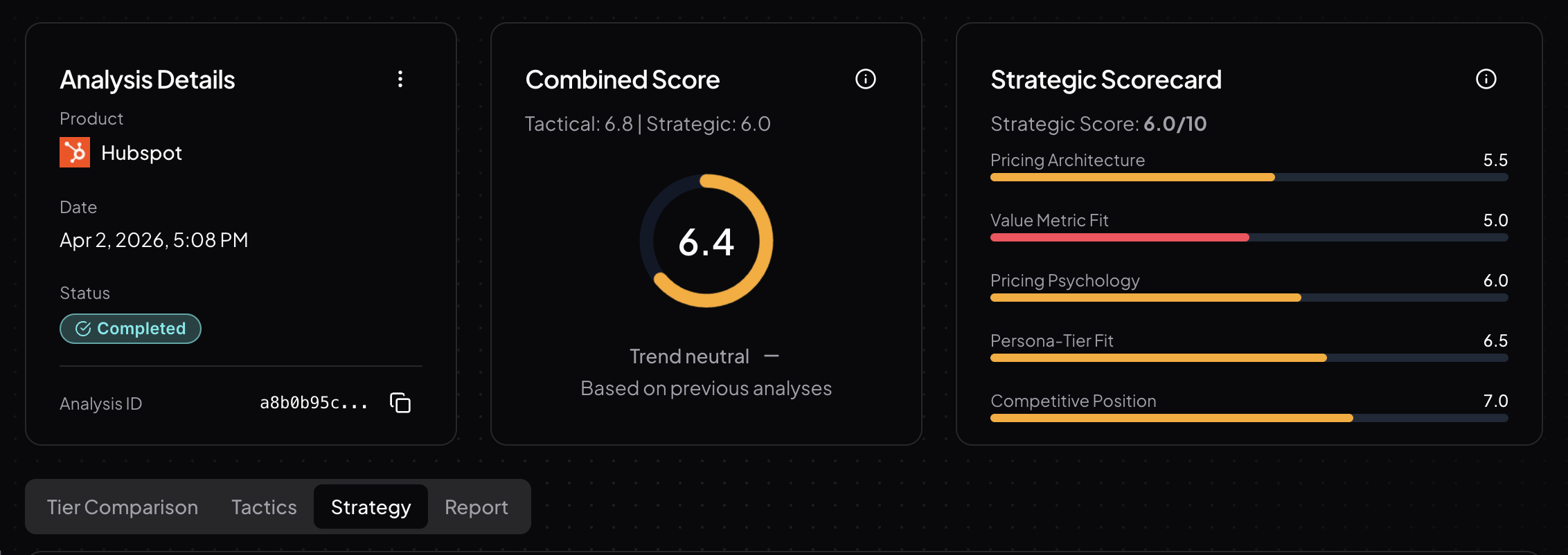 HubSpot pricing analysis on Tierly's dashboard showing tier scores and strategic assessment across Free, Starter, Professional, and Enterprise
Tierly scores seven attributes per tier (name clarity, pricing, seat flexibility, billing terms, feature depth, description quality, and conversion signals) plus five strategic dimensions. Here is how the strategic picture breaks down.
HubSpot Strategic Pricing Assessment
| Dimension | Score | Key Finding |
|---|---|---|
| Value Metric Alignment | 5/10 | Flat bundles with fixed seat caps do not scale with marketing contacts, making the 58.7x leap feel arbitrary compared with per-seat competitors |
| Pricing Architecture | 5.5/10 | Four-tier ladder exists, but the Starter-to-Professional gap is the biggest conversion break in the analysis |
| Pricing Psychology | 6/10 | Enterprise anchor (€3,330) helps frame lower tiers, but no charm pricing, no tier badge, and wildly inconsistent annual discounts (40% vs 10%) |
| Persona-Tier Fit | 6.5/10 | Free and Enterprise serve their personas well, but mid-market marketing teams (3-10 users) have no accessible tier |
| Competitive Positioning | 7/10 | Premium stance at €1,408 avg paid price vs Salesforce (€332) and Freshworks (€43), supported by a product score equal to the best competitor (6.8) |
The 7/10 on Competitive Positioning is HubSpot's strategic anchor. The platform earns its premium through product breadth, ecosystem depth, and brand trust. But the 5/10 on Value Metric and 5.5/10 on Pricing Architecture mean the pricing page does not communicate that premium effectively. Buyers can see HubSpot is expensive. They cannot easily see why.
HubSpot Tier Score Breakdown
| Tier | Score | Strongest Attribute | Weakest Attribute |
|---|---|---|---|
| Free | 7.5/10 | Conversion Signals (8/10) | Feature Depth (7/10) |
| Starter | 7.5/10 | Features (7/10) | Seats (6/10) |
| Professional | 6.3/10 | Features (8/10) | Price (3/10) |
| Enterprise | 6.1/10 | Features (9/10) | Price (2/10) |
The pattern is clear: HubSpot's feature scores increase as you move up the ladder (7 → 7 → 8 → 9), but price scores collapse (N/A → 7 → 3 → 2). The product gets stronger at every tier. The pricing page fails to justify it.
Lesson 1: The 58.7x Starter-to-Professional Jump Is the Biggest Value Ladder Break in CRM Pricing
HubSpot Professional scores 6.3/10 overall. The individual attribute scores tell a split story: features score 8/10, description scores 8/10, but price scores 3/10. That 3/10 is the second-lowest price score in any tier we have analyzed (behind only HubSpot's own Enterprise at 2/10).
What HubSpot gets right with Professional:
⦿ Omni-channel marketing automation. Professional unlocks the campaign orchestration capabilities that justify calling HubSpot a marketing platform rather than an email tool. This is the tier where HubSpot's product moat becomes visible.
⦿ Lead scoring and advanced personalization. These features create genuine differentiation against Salesforce Pro Suite (€100/mo) and Freshworks Pro (€47/mo), both of which offer comparable automation but with less marketing-specific depth.
⦿ Custom reporting. The ability to build custom reports and dashboards at the Professional level is competitive with enterprise-tier analytics from Microsoft Dynamics 365 and Zendesk.
The insight for founders:
The problem is not Professional's features. It is the gap between Starter and Professional that buyers need to cross to reach them.
Compare HubSpot's step-up ratios against every competitor in this analysis:
- Salesforce: Free → €25 → €100 → €175 (4x, then 1.75x)
- Freshworks: €11 → €47 → €71 (4.3x, then 1.5x)
- Microsoft Dynamics 365: €65 → €105 → €150 (1.6x, then 1.4x)
- Zendesk: €25 → €69 → €149 → €219 (2.8x, then 2.2x, then 1.5x)
- HubSpot: €15 → €880 → €3,330 (58.7x, then 3.8x)
No competitor in this set exceeds a 5x step-up between consecutive tiers. HubSpot's 58.7x is not just an outlier. It is a different category of pricing decision entirely.
The strategic analysis recommends inserting a Growth tier at €200-300/month with approximately 5 seats and 5,000 marketing contacts. This would create a Starter → Growth → Professional progression closer to 15x-then-3x, which is still aggressive but within the range where buyers can rationalize the step-up to their finance teams.
Consider more radical packaging restructurings rather than keeping the same plan structure and playing around with the plan prices.
Founder takeaway: If the ratio between any two consecutive tiers exceeds 5x, you probably have a missing tier, not a pricing problem. Map your upgrade path against competitors and look for the persona that falls into the gap. That persona is either churning or never converting.
Lesson 2: HubSpot's Free Tier Is Strong, But It Creates a Seat Regression Trap
HubSpot Free scores 7.5/10, tied with Starter for the highest tier in the entire analysis. That is not an accident. HubSpot has invested heavily in making its free CRM genuinely useful, and the score reflects real competitive strength.
What HubSpot gets right on Free:
⦿ 2 seats included. A two-person team can start using HubSpot's CRM, marketing, sales, and service tools without paying anything. This is generous and matches Salesforce Free Suite exactly.
⦿ No credit card required. The "Get started free" CTA with a trust note about no credit card is textbook low-friction activation. The conversion signals score 8/10, the highest of any tier in the analysis.
⦿ Five product areas accessible. Free Marketing tools, Free Sales tools, Free Service tools, Free Content tools, and Free Data tools. The breadth communicates platform value even if individual capabilities are limited.
The insight for founders:
The trap is not in Free. It is in what happens when a team on Free decides to upgrade.
HubSpot Free includes 2 seats. HubSpot Starter includes 1 seat. That means upgrading to Starter requires a team of two to either drop a collaborator or pay for an additional seat. The first paid step does not feel like gaining new capabilities. It feels like losing existing ones.
This is not hypothetical friction. Tierly's analysis flags Starter's seats score at 6/10 (the lowest attribute score on that tier), specifically because the Free-to-Starter transition creates cognitive dissonance. The buyer's internal narrative shifts from "we are getting more" to "we are getting less of something we already had."
Salesforce makes the same structural choice (Free Suite: 2 seats, Starter Suite: 1 seat), so this is not unique to HubSpot. But the impact is amplified in HubSpot's case because the rest of the Starter upgrade is modest: 1,000 marketing contacts, email marketing, forms, and simple automation. The feature upgrade does not overwhelm the seat downgrade.
The fix is straightforward: increase Starter to 2 seats, or introduce a clearly priced second-seat add-on that appears during the upgrade flow. The cost is minimal. The psychological improvement is significant.
The price a customer is willing to pay, and therefore the price a company can achieve, is always a reflection of the perceived value of the product or service in the customer's eyes.
Founder takeaway: Audit your free-to-paid transition for regressions. If any dimension (seats, storage, features, integrations) decreases when a user upgrades, you have introduced friction that competes with your upgrade value proposition. Every aspect of the paid plan should feel like a step forward.
Lesson 3: Flat Bundles With Hidden Contact Caps Are a Pricing Model Mismatch
HubSpot's Value Metric Alignment scores 5/10, tied for the weakest strategic dimension. The reason: HubSpot prices as a flat monthly bundle, but the actual upgrade triggers are contact volume and automation depth. These two things do not move together inside a flat structure.
What HubSpot gets right on value delivery:
⦿ Contact limits as upgrade fences. Free has no explicit contact limit, Starter caps at 1,000, Professional at 2,000, and Enterprise at 10,000. These limits do drive upgrade behavior, which means HubSpot already knows contacts are the usage metric that matters.
⦿ HubSpot Credits as a universal currency. The credits system (500 in Starter, 3,000 in Professional, 5,000 in Enterprise) creates a flexible resource that can be spent across features. This is a smart design for cross-hub products.
The insight for founders:
The mismatch is between what HubSpot charges for (flat bundles) and what buyers care about (contact volume and automation capabilities). Two of the five competitors in this analysis use per-seat pricing (Freshworks and Microsoft Dynamics 365), which scales linearly with team size. The other three use flat suite pricing (Salesforce, Zoho, Zendesk), but with much smaller step-ups between tiers.
HubSpot's flat bundles create three specific problems:
⦿ No intermediate contact option. The gap between 1,000 contacts (Starter, €15) and 2,000 contacts (Professional, €880) is enormous. A buyer whose list grows from 1,000 to 1,500 contacts faces the full 58.7x price increase to add 1,000 more contacts.
⦿ Hidden add-on pricing. Additional contacts beyond the included cap are available as add-ons, but these are not visible on the pricing page. A buyer cannot self-serve a "Starter + 2,000 extra contacts" configuration. The add-on path requires a sales conversation, which contradicts the self-serve positioning of the lower tiers.
⦿ Unpredictable cost scaling. Flat pricing with embedded contact caps makes it difficult for buyers to forecast costs as they grow. Per-seat pricing (Freshworks at €9-71/seat) is immediately predictable: multiply seats by price. Flat bundles with hidden overage structures are not.
The strategic analysis recommends shifting Professional and Enterprise to graduated contact-based pricing with visible add-ons per 1,000 contacts. This would align monetization with the metric that already drives upgrade behavior.
The only answers that matter are dollars spent. People answer when they pay for something. Put a price on it and put it up for sale.
Founder takeaway: If your pricing page charges flat rates but your upgrade fences are usage-based (contacts, API calls, storage, seats), your pricing model and your value metric are misaligned. Either price on the usage metric or make the flat bundle so generous that usage limits never feel arbitrary.
Lesson 4: Inconsistent Annual Discounts (40% vs 10%) Undermine Pricing Credibility
HubSpot's Pricing Psychology scores 6/10. The Enterprise anchor at €3,330/month is effective (it makes every lower tier look more accessible by comparison). But below the anchor, three implementation gaps erode the score.
What HubSpot gets right on pricing psychology:
⦿ Visible enterprise anchor. The €3,330 figure is displayed without gating, which means every buyer sees the top-end price before evaluating lower tiers. This is textbook anchoring and it works.
⦿ Annual billing toggle present. HubSpot does offer both monthly and annual billing options, which most competitors in this set also provide.
The insight for founders:
HubSpot offers a 40% annual discount on Starter (€15/month drops to €9/month billed annually) and a 10% annual discount on Professional (€880/month drops to €792/month billed annually). These two numbers, sitting on the same pricing page, tell contradictory stories.
A 40% discount on Starter signals one of two things: either the monthly price is artificially inflated, or HubSpot is desperate for annual commitment at entry level. Neither interpretation builds trust. The industry benchmark for annual SaaS discounts is 17-20%. Offering double that raises questions rather than closing deals.
Meanwhile, 10% on Professional barely registers as an incentive. At €880/month, that saves €88/month or €1,056/year. A 20% discount would save €2,112/year, a meaningful number for a mid-market team evaluating a €10,000+ annual commitment.
When buyers see 40% on one tier and 10% on another, they do not think "flexible pricing." They think "inconsistent pricing." Inconsistency in pricing erodes trust in every other claim on the page.
Beyond discounts, two more psychology gaps stand out:
⦿ No charm pricing. Every price is a round number: €15, €880, €3,330. Charm pricing (€14.99, €799, €2,999) is a small change with documented 5-8% conversion impact on self-serve tiers.
⦿ No tier badge. No plan carries a "Most Popular" or recommended label, despite Zendesk demonstrating exactly how effective this technique is with its badged Suite Professional.
We don't have an internal value meter that tells us how much things are worth. Rather, we focus on the relative advantage of one thing over another, and estimate value accordingly.
Founder takeaway: Pick one annual discount percentage and apply it consistently across all tiers. If you offer 20% on your entry tier, offer 20% on your mid-tier and enterprise tier. Inconsistency creates more buyer skepticism than a smaller, consistent discount ever would.
Lesson 5: Enterprise at €3,330/mo With a Hidden €6,830 Onboarding Fee Is a Conversion Barrier
Enterprise is HubSpot's lowest-scoring tier at 6.1/10. The features score 9/10 (the highest of any tier in the analysis). The price scores 2/10 (the lowest). The gap between those two numbers captures the entire Enterprise problem: the product is strong, but the pricing page fails to justify it.
What HubSpot gets right with Enterprise:
⦿ Customer journey analytics. End-to-end journey mapping and analytics at the Enterprise level is a genuine differentiator against Freshworks Enterprise (€71/mo) and Zendesk Suite Enterprise (€219/mo), neither of which offers equivalent marketing journey capabilities.
⦿ Multi-touch revenue attribution. Attribution modeling that connects marketing activities to revenue outcomes is the feature that CMOs use to justify their budget. Including it at Enterprise is correct positioning.
⦿ Access controls and email approvals. Governance capabilities (limiting access to content and data, requiring email approvals) serve the compliance and brand control needs of large marketing organizations.
The insight for founders:
Enterprise's pricing page representation has four compounding problems:
-
Hidden onboarding cost. The required €6,830 onboarding fee is disclosed in a footnote below the pricing cards. The actual first-year cost is not €3,330 x 12 = €39,960. It is €39,960 + €6,830 = €46,790. Discovering that number after initial pricing evaluation damages trust at the exact moment trust matters most.
-
No tier badges. No tier on HubSpot's pricing page carries a "Most Popular" or recommended label. Zendesk places "Most Popular" on Suite Professional. Salesforce's smooth pricing ladder (€25 to €100 to €175) guides buyers without one, but HubSpot's 58.7x gap makes a badge even more important because buyers need explicit guidance about which tier to evaluate first.
-
Only 5 seats at €3,330/month. Enterprise targets "large multi-team marketing organizations," but includes just 5 seats. Microsoft Relationship Sales starts at 10. Freshworks Enterprise serves "mid to large-sized businesses" at €71/seat. Five seats at €3,330/month creates a per-seat cost of €666/month, which is difficult to rationalize in any enterprise procurement process.
-
Credits-first feature framing. The feature list leads with "5,000 HubSpot Credits" rather than governance outcomes. Enterprise buyers do not purchase based on credit allocations. They purchase based on what those credits enable: journey automation, attribution, compliance, and team management.
It is virtually impossible to build a meaningful business off of $9 or $19 per month unless you achieve massive distribution.
Founder takeaway: If your enterprise tier has a mandatory onboarding fee, place it next to the monthly price, not in a footnote. Enterprise buyers respect transparency. They do not respect discovering hidden costs during procurement. Every dollar of surprise cost damages trust more than it would have damaged conversion if disclosed upfront.
How HubSpot Compares to Salesforce, Zoho, Dynamics 365, Freshworks, and Zendesk
Tierly's analysis benchmarked HubSpot against five competitors across equivalent tier matches. Here is the full competitive picture.
| Product | Free Tier | Entry Paid (/mo) | Mid-Tier (/mo) | Enterprise | Score |
|---|---|---|---|---|---|
| HubSpot | Free (2 seats) | Starter: €15 | Professional: €880 | €3,330/mo | 6.4/10 |
| Salesforce | Free Suite (2 seats) | Starter: €25 | Pro Suite: €100 | Mktg Cloud: €1,500 | 6.3/10 |
| Zoho One | N/A | All Employee: €45 | Flexible: €105 | N/A | 6.5/10 |
| Dynamics 365 | N/A | Professional: €65 | Enterprise: €105 | Contact Sales | 6.4/10 |
| Freshworks | N/A | Growth: €11 | Pro: €47 | Enterprise: €71 | 6.8/10 ⬆ |
| Zendesk | N/A | Support Team: €25 | Suite Pro: €149 | Suite Enterprise: €219 | 6.5/10 |
HubSpot and Salesforce are the only platforms offering free tiers in this competitive set, which gives both a structural advantage for top-of-funnel acquisition. But the similarity ends at the first paid step.
Three things stand out from the comparison:
⦿ Freshworks leads the set at 6.8/10. At entry-level prices matching HubSpot's annual Starter rate (€9 vs €9), Freshworks delivers per-seat scaling, AI-powered lead scoring by Freddy AI, and a clean three-tier architecture. For price-sensitive teams, it is the most credible HubSpot alternative.
⦿ Salesforce has the best pricing architecture. The €0 to €25 to €100 to €175 progression creates predictable step-ups that buyers can evaluate without a calculator. HubSpot's product breadth may justify premium pricing, but the architecture should communicate that premium clearly.
⦿ Zendesk demonstrates the psychology HubSpot is missing. A "Most Popular" badge on Suite Professional, clean per-seat pricing, consistent annual discounts, and a transparent 4-tier ladder. Its pricing page execution sets the benchmark for buyer-friendly design.
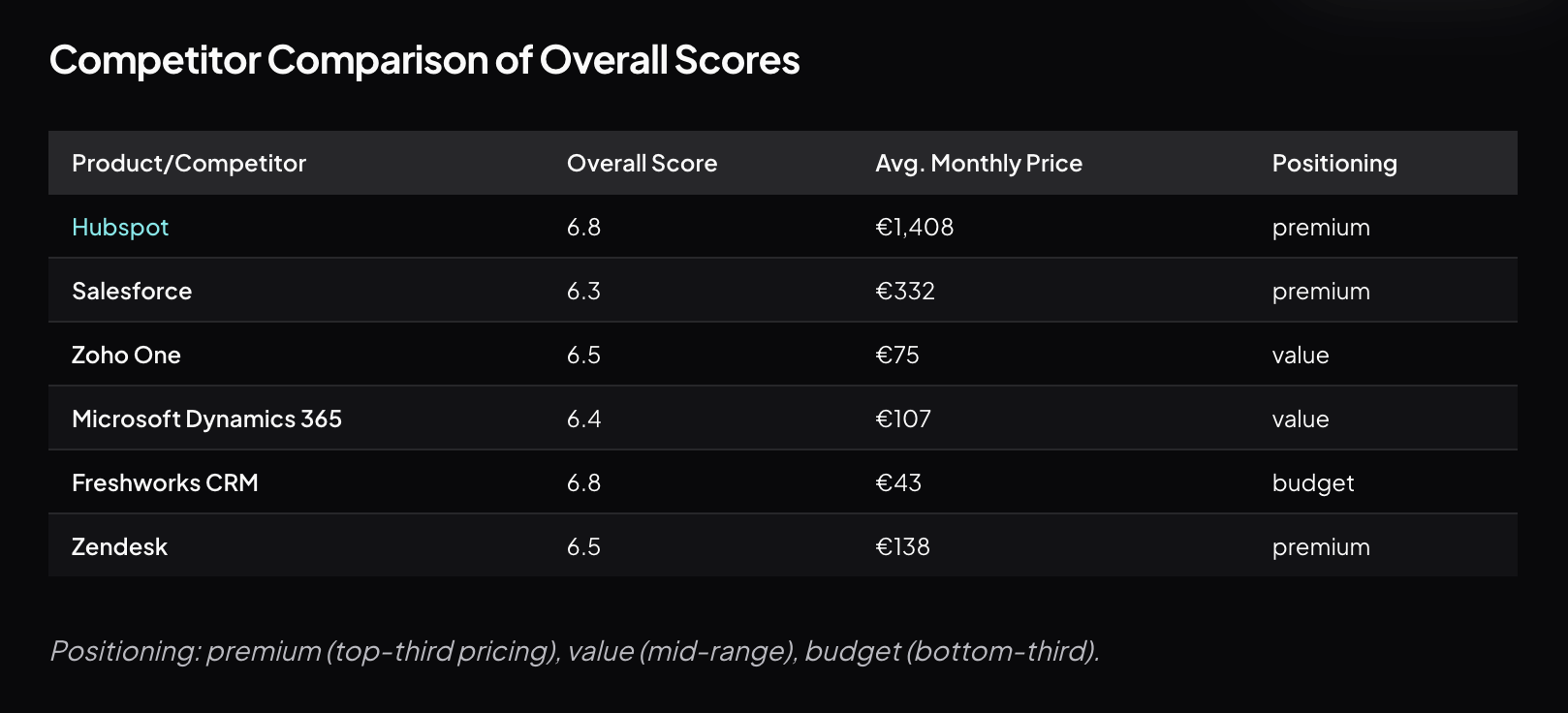 HubSpot competitor pricing comparison from Tierly showing combined scores for Salesforce, Zoho One, Microsoft Dynamics 365, Freshworks CRM, and Zendesk
What Tierly Recommends for HubSpot
Based on the full analysis, seven recommendations would meaningfully improve HubSpot's pricing effectiveness. The first three require no product changes.
HubSpot Tier-by-Tier Recommendations
| Tier | Recommendation | Expected Impact |
|---|---|---|
| Free | Replace generic feature buckets ('Free Marketing tools') with named capabilities (email sends, basic forms, lead capture) and add '2 users included' beneath the CTA | Improves Free activation rate; sets clearer upgrade expectations |
| Starter | Increase from 1 seat to 2 seats to eliminate the Free-to-Starter seat regression | Removes the single biggest psychological friction point in the upgrade path |
| Starter | Normalize annual discount to 20% (€12/mo annual) and apply charm pricing (€14.99/mo monthly) | Consistent discount framing builds trust; charm pricing lifts self-serve conversion 5-8% |
| New Tier | Insert a Growth tier at €249/mo with 5 seats and 5,000 contacts between Starter and Professional | Captures mid-market teams currently lost in the 58.7x gap; creates a viable upgrade path |
| Professional | Reset to €799/mo with 5 seats, 20% annual discount, and disclose €2,930 onboarding fee next to the price | Improves price score from 3/10; reduces buyer surprise at procurement stage |
| Enterprise | Reframe as €2,999/mo base with visible add-ons per 1,000 contacts, expand seats from 5 to 10 | Aligns value metric to contacts; matches Microsoft's enterprise seat benchmark |
| Pricing Page | Add 'Most Popular' badge to Professional (or new Growth tier) and apply charm pricing to all self-serve tiers | Guides undecided buyers toward the target tier; closes the 6/10 Psychology gap |
The highest-leverage recommendation: insert the missing Growth tier. The 58.7x gap is not just a pricing problem. It is a conversion gap that costs HubSpot every mid-market team that evaluates Starter, wants more, looks at Professional, and decides the jump is not justifiable.
For a deeper look at how step-up ratios and value ladders affect SaaS conversion, see the SaaS pricing audit framework. To run this kind of analysis on your own product, start a free analysis at Tierly.
HubSpot Pricing FAQ
How much does HubSpot Marketing Hub cost in 2026?
Is HubSpot's free CRM plan worth it?
Why is HubSpot so expensive compared to competitors?
What is the difference between HubSpot Starter and Professional?
How does HubSpot pricing compare to Salesforce?
Is HubSpot worth it for small businesses?
What are HubSpot's hidden costs?
What is the best HubSpot alternative for startups?
The 5 Pricing Lessons from HubSpot
HubSpot is a category-defining platform. Its CRM, marketing automation, and inbound methodology have shaped how an entire generation of SaaS companies thinks about customer acquisition. But pricing sophistication and product sophistication are separate disciplines, and this teardown shows the gap clearly.
✦ Lesson 1: A 58.7x step-up is not a pricing tier. It is a missing tier. If the ratio between any two consecutive plans exceeds 5x, you almost certainly have a mid-market persona falling into the gap. Map your upgrade path against competitors and look for the buyers who cannot afford to step up.
✦ Lesson 2: Free-to-paid transitions should never feel like a downgrade. Dropping from 2 seats to 1 on upgrade creates cognitive friction that competes with your upgrade value proposition. Every dimension of the paid plan should represent forward progress.
✦ Lesson 3: If your upgrade fences are usage-based, your pricing model should be too. Flat bundles with hidden contact caps create unpredictable costs. Either price on the metric that drives upgrades (contacts, seats, automation runs) or make the flat bundle generous enough that limits feel irrelevant.
✦ Lesson 4: Inconsistent annual discounts erode trust. A 40% discount on one tier and 10% on another tells buyers your pricing logic is arbitrary. Pick a single percentage (17-20% is the industry benchmark) and apply it uniformly.
✦ Lesson 5: Hidden onboarding fees are hidden trust destroyers. A €6,830 surprise in a footnote damages buyer confidence more than it would have damaged conversion if disclosed alongside the monthly price. Enterprise buyers respect transparency. They do not respect discovering costs during procurement.
The gap between Tierly's 6.4/10 and a market-leading 8+ is not in HubSpot's product. It is in the pricing page that represents it. The 58.7x cliff, the seat regression, the inconsistent discounts, and the hidden onboarding fees are all fixable without changing a single product feature. For a platform that taught the SaaS industry how to do inbound marketing, applying that same rigor to its own pricing page would close the gap between how good HubSpot is and how good its pricing makes it look.
We analyzed Slack's per-seat pricing model against Zoom, Google Workspace, Pumble, and Webex. 5 lessons on freemium limits, AI gating, and enterprise transparency.
We analyzed Intercom's dual-layer pricing model against five competitors. 5 lessons on value metric choice, add-on architecture, and enterprise packaging for customer communication SaaS.
A step-by-step framework for auditing your SaaS pricing, covering value metrics, competitive positioning, tier architecture, and pricing psychology.
Compare the top tools for competitive pricing intelligence, from manual benchmarking approaches to AI-powered platforms like Tierly.
Everything you need to know about building a competitive pricing intelligence process, from data collection to strategic action and continuous benchmarking.
Related Posts
Slack Pricing Teardown: What SaaS Founders Can Learn
A strategic analysis of Slack's pricing structure using Tierly's competitive intelligence. 5 lessons on collaboration pricing against Zoom, Google Workspace, Webex, and Pumble.
Monday.com Pricing Teardown: What SaaS Founders Can Learn
A strategic analysis of Monday.com's pricing structure using Tierly's competitive intelligence. 5 lessons on pricing a multi-product work platform against Asana, ClickUp, Trello, Smartsheet, and Wrike.
Intercom Pricing Teardown: What SaaS Founders Can Learn
A strategic analysis of Intercom's pricing structure using Tierly's competitive intelligence. 5 lessons on pricing AI-powered customer service against Zendesk, Freshdesk, Kustomer, Gorgias, and Dixa.